
The right car inverter can turn a vehicle’s 12V outlet into a practical power source for laptops, cameras, tablets, chargers, and other travel essentials. The best choice depends on the devices you need to run, the inverter’s continuous wattage, and how often you expect to use it.
We’ve gathered 10 car inverters for road trips across several power levels and designs, including compact plug-in models, USB-focused options, and higher-capacity units. Use the guide below to compare features and choose a safer, more convenient fit for your vehicle and itinerary.
Best 10 Car Inverters for Road Trips Picks for 2026
Best Pure Sine Wave Pick
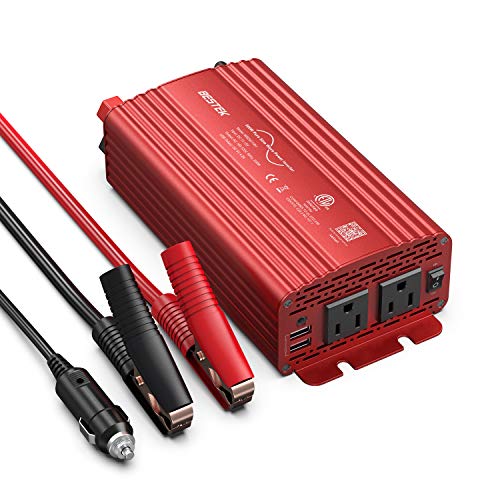
- Pure sine wave output for sensitive electronics
- Two AC outlets and dual USB charging
- Battery clamps support higher loads
Best For: Sensitive electronics and higher-power road-trip setups
Best Family Road-Trip Value

- 400W continuous and 800W peak output
- Dual AC sockets plus two 3.1A USB ports
- Compact design with a 30-inch cord
Best For: Families charging several travel devices
Best Long-Warranty Pick

- 300W continuous output with 700W instantaneous power
- Two AC outlets and 4.8A dual USB charging
- Compact aluminum body with broad vehicle compatibility
Best For: Moderate-power travel devices and warranty-conscious buyers
Best Compact Budget Pick

- Ultra-compact eight-ounce design
- 150W continuous and 300W peak output
- AC outlet plus two USB charging ports
Best For: Basic charging and small electronics in limited space
Best Overall
BESTEK 400W Road-Trip Inverter

- 400W output with two 110V AC outlets
- 30W USB-C PD and QC 3.0 USB-A charging
- Compact ETL-certified design with 12-month warranty
Best For: Travelers needing AC power and fast USB charging
Best Port Selection

- Two AC outlets and four USB ports
- 65W USB-C port for compatible laptops
- LCD voltage display and quiet, demand-based fan
Best For: Groups charging several devices simultaneously
Best Compact Value

- Phone-sized design for easy storage
- Two AC outlets plus four USB ports
- 18W QC and 20W USB-C fast charging
Best For: Compact charging for small travel electronics
High-Capacity Choice
MOVFFGGRM 500W Vehicle Power Inverter
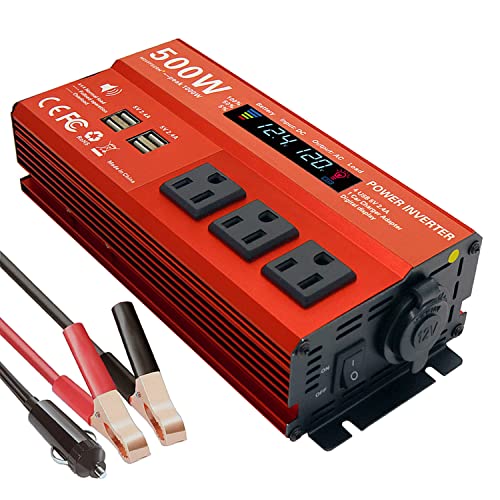
- 500W continuous, 1,000W peak output
- Three AC outlets plus four USB ports
- Includes plug and direct-battery clips
Best For: Multiple devices and higher-load 12V use
Compact Travel Pick
PiSFAU 300W Car Power Inverter

- Six ports for simultaneous charging
- Two 24W USB-C and two 24W USB-A ports
- Compact 300W cigarette-lighter design
Best For: Portable charging of personal electronics
Monitoring Favorite
DrimMek 300W Road-Trip Inverter

- Two AC outlets and three 24W USB ports
- LCD voltage and error-code display
- Quiet, temperature-controlled cooling fan
Best For: Travelers wanting charging status and fast USB power
Best Pure Sine Wave Pick – 500W BESTEK Inverter
For car inverters for road trips, this BESTEK model stands out when you need cleaner power for sensitive electronics. Its 500W pure sine wave output, two AC outlets, and dual USB charging ports offer flexible power from a 12V vehicle system.
Best For: Travelers powering sensitive electronics, cordless tools, or multiple devices who can connect directly to the battery for higher loads.
Pros:
- Pure sine wave output is designed for sensitive electronics and inductive loads.
- Offers two AC outlets and two USB ports with up to 4.2A total USB output.
- Includes both a cigarette-lighter cable and battery clamps.
- Built-in protections cover overload, overheating, voltage issues, reverse polarity, and short circuits.
Cons:
- The cigarette-lighter connection should generally stay under 150W; higher output requires battery clamps.
- The cooling fan can run when the inverter becomes hot.
- Overload protection shuts down AC power and requires a power-cycle reset.
This is the strongest choice here for cleaner AC power and heavier-duty flexibility, but its full 500W rating depends on a direct battery connection rather than a standard 12V outlet.
Best Family Road-Trip Value – Pro Chaser 400W Inverter
This Pro Chaser is a practical option among car inverters for road trips, combining 400W of continuous output with dual AC sockets and dual 3.1A USB ports. Its compact body and 30-inch cord make it easy to position in a vehicle.
Best For: Families and travelers charging phones, tablets, cameras, laptops, breast pumps, DVD players, or bottle warmers on the go.
Pros:
- Provides 400W continuous output with an 800W peak rating.
- Includes two 110V AC sockets and two USB ports rated at 3.1A each.
- Compact cellphone-sized design and 30-inch cord improve placement flexibility.
- Includes overload, voltage, and overheating protection plus a 12-month warranty.
Cons:
- Modified sine wave output may be less suitable for some sensitive electronics than pure sine wave power.
- It is intended for use in a cool, dry environment.
- The cooling fan activates at about 113°F (45°C).
With plenty of charging connections in a small package, this model is well suited to everyday vehicle use when your devices are compatible with modified sine wave output.
Best Long-Warranty Pick – BESTEK 300W Inverter
For shoppers comparing car inverters for road trips, this 300W BESTEK offers a compact way to run small AC devices and charge USB gear. It supports 11–17V vehicle systems, includes two AC outlets, and comes with a 32-inch cigarette-lighter cord.
Best For: Road travelers who want a compact inverter for laptops, tablets, phones, cameras, and other moderate-power devices, including compatible 11–17V vehicles.
Pros:
- Provides 300W continuous output and 700W instantaneous power.
- Two AC outlets and two 4.8A USB ports support multiple devices.
- Compact, lightweight aluminum housing is easy to carry.
- Includes multi-protection features and a five-year product replacement warranty.
Cons:
- Modified sine wave output is not the same as pure sine wave power.
- Its cigarette-lighter connection is designed for vehicle use rather than maximum high-load operation.
- The fan may run faster above 70W or as the unit warms.
This is a sensible middle-ground inverter for common road-trip electronics, especially if a long warranty and broad 11–17V compatibility matter more than pure sine wave output.
Best Compact Budget Pick – 150W PiSFAU Inverter
This compact PiSFAU model is a convenient entry-level choice among car inverters for road trips. It delivers 150W continuously from a 12V outlet, with one AC outlet and two USB ports for everyday electronics.
Best For: Travelers who need a small, easy-to-pack inverter for phones, tablets, laptops, lights, game consoles, and other modest-power devices.
Pros:
- Small 3.4-by-2.5-by-1.5-inch design weighs about eight ounces.
- Provides 150W continuous output and 300W peak power.
- Includes an AC outlet and two USB charging ports.
- Smart-chip and fuse protection address overheating, voltage issues, overload, and short circuits.
Cons:
- 150W continuous output limits the size and number of AC devices you can run.
- Modified sine wave output may not suit every sensitive device.
- It is intended for a 12V vehicle connection rather than a direct battery setup.
Choose this model when portability and basic charging are the priorities. Its modest output is best matched with small electronics instead of high-demand appliances.
Best Overall – BESTEK 400W Road-Trip Inverter
For shoppers comparing car inverters for road trips, the BESTEK 400W model offers a useful balance of AC power and fast USB charging. Its two 110V outlets support devices rated from 300W to 400W, while USB-C PD and USB-A QC ports handle everyday mobile gear.
Best For: Travelers who need higher output for laptops, DVD players, breast pumps, or bottle warmers alongside phones and tablets.
Pros:
- 400W output with dual 110V AC outlets.
- Includes 30W USB-C PD and USB-A QC 3.0 charging.
- Compact, ETL-certified design with built-in 40-amp fuse.
- 12-month replacement warranty and 24/7 technical support.
Cons:
- Higher-wattage appliances should remain within the stated 300W-to-400W range.
- Designed for 12V vehicle outlets, so compatibility should be checked before purchase.
This is the strongest all-around choice in the group when you want both AC outlet capacity and modern USB charging in a compact road-trip adapter.
Best Port Selection – DrimMek 300W Car Inverter
The DrimMek 300W is a practical pick among car inverters for road trips when several passengers need to charge devices at once. It combines two AC outlets with two USB-C ports, including a 65W port, two USB-A ports, and a voltage display.
Best For: Road-trip passengers charging a laptop, phones, and tablets simultaneously from a compact 12V outlet adapter.
Pros:
- Two AC outlets plus four USB ports.
- 65W USB-C port can charge compatible laptops.
- LCD display shows real-time vehicle battery voltage.
- Quiet fan runs only when needed, with multiple safety protections.
Cons:
- Uses a modified sine wave output.
- Not compatible with Tesla vehicles equipped with 16V low-voltage systems.
- Total output is limited to 300W.
Choose this model for its unusually flexible port layout and battery-voltage readout, especially if simultaneous charging matters more than maximum AC capacity.
Best Compact Value – YSOLX 200W Travel Inverter
The YSOLX 200W is a compact option for shoppers seeking car inverters for road trips without needing high-wattage appliance support. It provides two AC outlets, four USB ports, and fast-charge options in a phone-sized adapter intended for small electronics.
Best For: Travelers who primarily need to charge phones, tablets, laptops, or a gaming console from a compact vehicle adapter.
Pros:
- Small 5-by-2.7-by-1.4-inch design weighing about 8.5 ounces.
- Two AC outlets and four USB ports offer flexible charging.
- Includes 18W USB-QC and 20W USB-C charging.
- Protection covers over-voltage, overload, overheating, under-voltage, and short circuits.
Cons:
- 200W output is lower than the other options in this roundup.
- Uses modified sine wave output.
- The indicator may turn red when its protection mechanism activates.
This is a sensible space-saving choice for basic road-trip electronics, provided your devices stay within its 200W output limit.
High-Capacity Choice – MOVFFGGRM 500W Vehicle Power Inverter
For shoppers comparing car inverters for road trips, the MOVFFGGRM stands out when you need more output than a basic phone charger. It provides 500W of continuous power, 1,000W peak output, three AC outlets, four USB ports, and a cigarette-lighter outlet. The included plug and battery clips add flexibility, though higher loads require direct battery connection.
Best For: Road-trip travelers who need to run several small electronics or connect higher loads directly to a 12V battery.
Pros:
- 500W continuous and 1,000W peak output.
- Three AC outlets, four 2.4A USB ports, and one cigarette-lighter outlet.
- Includes both a cigarette-lighter plug and battery clips.
- Aluminum body, cooling fan, LCD display, and multiple protection features.
Cons:
- Uses a modified sine wave rather than a pure sine wave.
- Loads above 150W should use the included battery clips instead of the cigarette-lighter socket.
- Larger and heavier than compact plug-in models.
This is the most versatile option in the group for users who want multiple outlets and a higher power ceiling. Keep the cigarette-lighter fuse limitation in mind, and use the direct-battery connection when the load exceeds 150W.
Compact Travel Pick – PiSFAU 300W Car Power Inverter
The PiSFAU is a practical choice among car inverters for road trips when portability and simultaneous charging matter most. Its compact body provides two AC outlets, two USB-C ports, and two USB-A ports, while the 300W output is suited to laptops and other modest electronics.
Best For: Travelers who want a lightweight cigarette-lighter inverter with plenty of charging ports for personal electronics.
Pros:
- Six total charging ports, including two 24W USB-C and two 24W USB-A ports.
- Two AC outlets for compatible small devices.
- Compact, lightweight design measuring about 5.4 by 2.7 by 1.3 inches.
- Protection against overheating, undervoltage, overvoltage, overload, and short circuits.
Cons:
- 300W output is less than the MOVFFGGRM’s continuous rating.
- Modified sine wave output may not suit every sensitive device.
- Designed for cigarette-lighter use rather than direct battery connection.
With its small footprint and six ports, the PiSFAU is well suited to keeping phones, tablets, laptops, and similar gear charged without taking much cabin space. It is a better fit for everyday electronics than demanding appliances.
Monitoring Favorite – DrimMek 300W Road-Trip Inverter
The DrimMek combines a 300W AC inverter with fast USB charging and an LCD status display, making it a strong option among car inverters for road trips. Its two AC outlets, three 24W USB ports, voltage monitoring, and temperature-controlled fan provide useful control in a compact cigarette-lighter design.
Best For: Road warriors who want fast USB charging and a display showing vehicle voltage and error codes.
Pros:
- Two AC outlets plus three 24W USB-C/USB-A charging ports.
- LCD shows voltage from 11V to 15V and error codes.
- Temperature-controlled fan activates at 113°F/45°C and operates at about 35dB.
- Compact 0.64-pound design with overload, overvoltage, overheating, and short-circuit protection.
Cons:
- 300W output is intended for smaller electronics and appliances.
- Modified sine wave output is not pure sine wave.
- Uses a cigarette-lighter power source rather than direct battery clips.
The DrimMek is especially appealing if you value visibility and quieter cooling alongside charging capacity. Its compact form fits easily in a glove box or travel bag, while the 300W rating keeps it focused on electronics and other modest loads.
How We Picked the Best Car Inverters for Road Trips
We focused on the specifications that matter most during vehicle travel: continuous output, peak capacity, outlet and USB configuration, charging convenience, portability, and suitability for a standard 12V car socket. The selection includes models from 150W to 500W continuous output, giving shoppers options for basic electronics as well as several simultaneous low-power devices.
We also considered practical details such as USB-C availability, built-in cooling, compact designs, and protection features commonly listed by manufacturers, including overload, short-circuit, overheat, and low-voltage safeguards. Always verify the exact specifications for the model you select before connecting equipment.
Quick Comparison
- For phones, tablets, and small accessories: A 150W or 200W inverter is typically sufficient and is often easy to store.
- For laptops and several devices: Look at 300W models with multiple AC or USB ports.
- For heavier combined loads: A 400W or 500W inverter provides more headroom, provided your vehicle outlet supports the required current.
- For modern charging: Prioritize USB-C, especially if your phone, tablet, or laptop supports USB-C Power Delivery.
Key Buying Factors for Car Inverters for Road Trips
Continuous and Peak Wattage
Continuous wattage is the most important number because it describes the load the inverter can sustain. Peak or surge wattage is reserved for brief startup demands and should not be treated as the regular operating rating. Add the wattage of everything you may run at once, then leave a safety margin.
Vehicle Outlet Limits
A high-rated inverter may not be able to deliver its maximum output through a standard 12V accessory socket. Larger loads can draw substantial current, so check your vehicle manual, the inverter instructions, and the fuse rating. Do not exceed the outlet’s capacity or use a damaged extension cable.
Waveform and Device Compatibility
Pure sine wave models generally provide cleaner AC power and are the safer choice for sensitive, motor-driven, or medical equipment. Many basic electronics work with modified-wave designs, but check manufacturer guidance before powering anything valuable or specialized.
Ports, Heat, and Convenience
Count the AC outlets and USB ports you actually need. USB-C can reduce adapters, while multiple USB-A ports help with phones and smaller accessories. Ventilation and an accessible power switch are useful during extended use. Keep the inverter unobstructed and never operate it inside a closed compartment.
Who Should Buy Which Car Inverters for Road Trips?
Choose a compact 150W–200W model if your priority is charging phones, tablets, cameras, handheld consoles, or a single small laptop. These are convenient for occasional use and typically place less demand on the vehicle socket.
Choose a 300W model for the best balance of versatility and size. It suits travelers carrying a laptop, camera batteries, tablets, and several USB devices, particularly when USB-C is included.
Choose a 400W–500W model if you need multiple outlets or extra capacity for several low-to-moderate loads. Confirm your car’s electrical limits first, and remember that an inverter is not a substitute for a household generator or a properly installed high-capacity power system.