
A car ionizer can be a compact way to address everyday odors, but the right choice depends on where you can place it and how you want to power it. Some models occupy a 12V socket and add USB ports; others fit a cup holder or use a rechargeable battery.
Here’s how to compare the six selected options without confusing odor control with the particle removal you’d expect from a filtered purifier.
Best 6 Car Ionizer Purifiers Picks for 2026
Cup-Holder Pick
SHARP Plasmacluster NEXT IG-NX15-W

- Automotive cup-holder design
- Simple button controls
- Listed for odors, pet dander, and pollen
Best For: Drivers seeking a straightforward cup-holder ionizer
Charger Combo
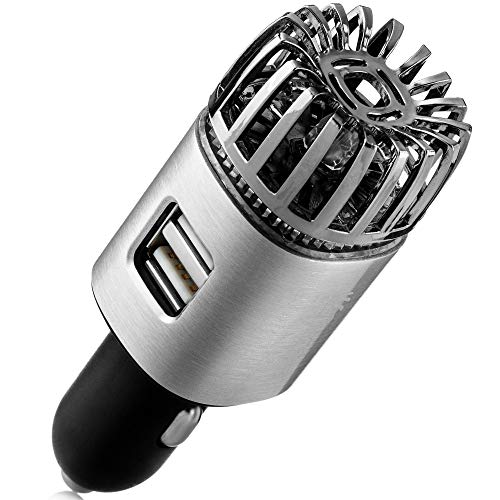
- 12V plug-in design
- Dual USB charging ports
- Seller describes gradual odor reduction
Best For: Drivers who need charging and ionization from one socket
Cord-Free Pick
Rechargeable Portable Car Ionizer

- Rechargeable, filterless design
- Cup-holder base included
- Intensive modes require unoccupied spaces
Best For: Portable use across vehicles and small indoor spaces
Best Silver Finish
4WDKING Car Ionizer with Dual USB
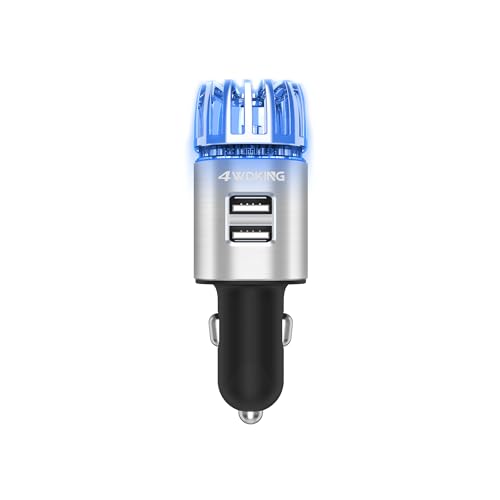
- Silver stainless steel body
- Two 2.1A USB ports
- Compact 12V plug-in design
Best For: Drivers who want a silver ionizer and USB charging in one outlet
Best Low-Upkeep Pick

- No replacement filters or refills
- Listed 30 dB operation
- Matte steel body with blue LED
Best For: Drivers who prioritize simple setup and minimal upkeep
Best Matte Copper Option

- Matte copper aluminum body
- Two built-in 2.1A USB ports
- Odor reduction takes time
Best For: Regular drivers who want a muted metallic finish and USB charging
Cup-Holder Pick – SHARP Plasmacluster NEXT IG-NX15-W
SHARP IG-NX15-W [Plasmacluster NEXT Ion Generator for Automotive Cup Holder Type White]
Check Price On AmazonAmong car ionizer purifiers, the SHARP IG-NX15-W is a straightforward choice if you want an ion generator designed for an automotive cup holder. It has button controls and a white finish.
Best For: Drivers who want a cup-holder-style ionizer with simple controls.
Pros:
- Designed for an automotive cup holder.
- Button control keeps operation straightforward.
- Listed for odors, pet dander, and pollen.
Cons:
- Ionizer design does not specify a replaceable particle filter.
- The supplied details do not state a coverage area.
Choose this for its car-focused form factor, but do not assume a stated room-size rating or mechanical filtration.
Charger Combo – 12V Car Ionizer with Dual USB
If your 12V socket also needs to charge devices, this is one of the car ionizer purifiers that combines an ionic deodorizer with dual USB ports. Its compact plug-in body requires no separate cup-holder space.
Best For: Drivers who want an ionizer and USB charging from one 12V socket.
Pros:
- Plugs into a vehicle’s 12V socket.
- Includes dual USB charging ports.
- Compact, 40 g design with a muted chrome finish.
Cons:
- Requires an available 12V socket while operating.
- The seller says odor reduction is gradual, not instant.
- The stated ozone output may be a concern for shoppers seeking an ozone-free device.
The charger makes it practical for daily drives, but treat the seller’s sweeping impurity-removal and germ-related claims cautiously; the supplied notes do not establish independent test results.
Cord-Free Pick – Rechargeable Portable Car Ionizer
For shoppers comparing car ionizer purifiers that can travel beyond the vehicle, this rechargeable model offers filterless operation and an included cup-holder base. The seller states coverage of up to 216 sq ft, though that figure is not a substitute for a stated particle-filtration rating.
Best For: Drivers who want a portable ionizer for the car, RV, and small indoor spaces.
Pros:
- Rechargeable battery supports cord-free use and operation while charging.
- Includes a cup-holder base for vehicle placement.
- Filterless design avoids replacement filters.
- Offers a quiet negative-ion mode and timed 15- and 30-minute intensive modes.
Cons:
- Intensive modes are specified for unoccupied spaces only.
- No replaceable particle filter is described.
Its flexible power and placement are the main advantages. Follow the occupancy restriction for intensive modes, and choose a filtration-based unit instead if capturing particles in a filter is your priority.
Best Silver Finish – 4WDKING Car Ionizer with Dual USB
Among car ionizer purifiers, this silver 4WDKING model pairs a 12V plug-in ionizer with two 2.1A USB ports. Its compact stainless steel body and blue LED suit drivers who want one outlet to handle both freshening and charging.
Best For: Drivers who want a silver, space-saving ionizer without giving up USB charging.
Pros:
- Two 2.1A USB ports charge devices while the ionizer runs.
- Plugs directly into a 12V outlet and needs no filter replacement.
- Blue LED helps you locate the unit and ports in the dark.
Cons:
- Occupies the vehicle’s 12V outlet.
- Produces a light ozone scent that may not appeal to everyone.
This is a practical two-in-one pick if charging access matters as much as cabin odor control; expect the ionizer to work while it is plugged in, rather than treating it as an instant fix.
Best Low-Upkeep Pick – 4WDKING Black 12V Ionizer
If you prefer car ionizer purifiers without filters or refills, this black 4WDKING unit plugs into a 12V outlet and runs at a listed 30 dB. Its matte steel body and blue LED ring offer a discreet look for everyday drives.
Best For: Drivers seeking a straightforward, filter-free plug-in freshener for routine commutes.
Pros:
- Requires no replacement filters or refills.
- Listed 30 dB operation keeps noise modest.
- Blue LED ring makes the unit easier to find in the dark.
Cons:
- Takes up a 12V outlet while in use.
- Its ozone-like scent may be noticeable to scent-sensitive passengers.
Choose this model for simple setup and minimal upkeep. Its ionization and ozone-freshening approach is geared toward ongoing odor control, not conventional filter-based air cleaning.
Best Matte Copper Option – Copper Ionizer with Dual USB
This matte copper option stands out among car ionizer purifiers for its muted-chrome outlet head, aluminum body, and built-in dual USB charging. It plugs into a 12V socket, so you can run the ionizer without surrendering device-charging access.
Best For: Drivers who want a muted metallic finish and dual USB ports, and can give odor reduction time.
Pros:
- Two built-in 2.1A USB ports add charging utility.
- Muted-chrome outlet head is designed to reduce distracting glare.
- Manufacturer specifies an ozone concentration of 0.05 ppm or less.
Cons:
- Manufacturer says odor reduction is not instant and may take 5–7 days of daily use.
- Ionizer sound can vary with temperature and humidity.
The dual-purpose design makes sense for regular drives, especially if you value the copper finish. Its own guidance recommends trips of around 30 minutes, so it is less compelling for drivers expecting immediate results on very short journeys.
How We Picked These Car Ionizer Purifiers
We focused on practical differences visible in the selected products: 12V plug-in versus rechargeable power, cup-holder versus outlet placement, dual USB charging, and stated coverage. We also considered whether a device is described as filterless, since that affects upkeep. The list includes very similar plug-in listings, so check the exact seller listing and specifications before treating them as different designs.
Product names make odor-control and antimicrobial claims, but a listing title alone cannot establish real-world performance. We did not treat a stated coverage area as proof that a device will clean every part of a vehicle, and we would not use ionization as a substitute for removing an odor source.
Quick Comparison
For a dedicated cup-holder setup, the SHARP IG-NX15-W is the distinct fit among these choices. If you want to keep charging devices while using a 12V outlet, compare the dual-USB plug-in models, including the 4WDKING options and the similarly named ionic deodorizer listings. If you would rather not occupy the outlet, the rechargeable, filterless portable model is the one to examine; its advertised 216-square-foot coverage is a specification to verify, not a guarantee of cabin performance.
Key Buying Factors for Car Ionizer Purifiers
Power and Placement
Check your vehicle’s available 12V outlets, cup holders, and clearance around the console. A plug-in unit is convenient when the outlet is accessible but may protrude or conflict with other accessories. A cup-holder device uses storage space, while a rechargeable model needs a charging routine. Confirm whether a product requires power continuously to operate.
Odors, Particles, and Air Movement
Ionizers and filterless devices should not be assumed to capture smoke particles, pollen, or fine dust the way a properly sized HEPA-filter purifier can. For persistent smoke, pet, or food odors, clean affected surfaces, replace the cabin air filter when appropriate, and address the source first. If measurable particle filtration is your priority, look for independently documented filtration performance rather than relying on an ionizer label.
Ozone, Charging, and Upkeep
Ask the seller or manufacturer for emissions information and any applicable ozone certification; avoid assuming that an “ionic” or “antimicrobial” claim means ozone-free or medically beneficial. For dual-USB models, verify port output against your phone’s charging needs and check that the device suits your vehicle’s 12V socket. Also compare cleaning instructions, warranty terms, and whether replacement parts are needed.
Who Should Buy Which Car Ionizer Purifiers?
Choose a cup-holder model if you have space for a dedicated unit and want to leave your 12V socket free. Choose a dual-USB plug-in model if simple installation and phone charging matter most; compare the near-duplicate listings on price, seller, warranty, and port specifications. Choose the rechargeable option if outlet access is limited or you want to move the device between vehicles. If allergies, wildfire smoke, or fine-particle removal are your main concern, prioritize a filtered air purifier instead of relying on Car Ionizer Purifiers alone.