
Electrical faults can turn a simple repair into hours of guesswork. A power probe tester helps you check voltage and ground at a circuit, then test certain components by applying power or ground when the tool and circuit allow it.
These 10 picks cover straightforward circuit testers and kits with extras such as back-probe leads or waveform displays. The right choice depends on what you work on, which functions you need, and how carefully you can access the circuit.
Best 10 Automotive Power Probe Testers Picks for 2026
Best Probe Accessory Kit
VDIAGTOOL V200 Pro Upgrade Kit

- 30-piece back-probe accessory set
- Wire tracing and component activation
- 40-foot cable for vehicle access
Best For: Frequent connector and harness testing
Best for Signal Analysis

- Live waveform and digital displays
- Injector and 4-/5-pin relay tests
- Battery, cranking, and charging checks
Best For: Diagnosing changing electrical signals
Best for Wire Tracing
VDIAGTOOL V200 Pro Circuit Tester

- Dedicated breaker-finder mode
- 20-foot cord plus 20-foot extension
- Component activation and overload protection
Best For: Tracing faults around larger vehicles
Best for Everyday Checks
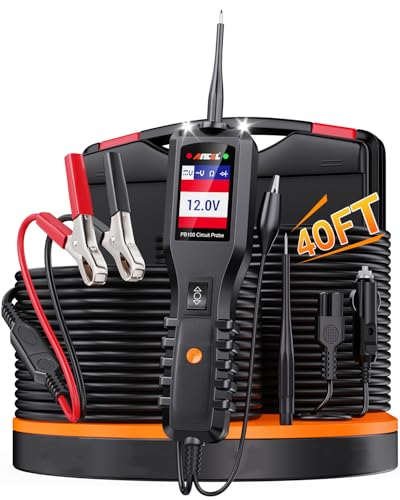
- Four core diagnostic modes
- Power or ground component activation
- LED and audible polarity feedback
Best For: Routine 6–30V electrical troubleshooting
Classic Circuit Tester

- Tests 12–24 VDC circuits
- Applies power or ground
- Includes a 20-foot cord
Best For: Dedicated circuit checks and component activation
Multi-Mode Diagnostic Pick

- Checks DC and AC voltage
- Shows polarity with LEDs and tones
- Activates compatible components
Best For: Varied circuit and component checks
Waveform Display Pick

- Color TFT waveform display
- Up to 40 feet of cable reach
- DC, AC, resistance, and diode modes
Best For: Visual signal checks across a vehicle
Best for Long-Reach Testing
Autel PowerScan Circuit Tester

- 20-foot cable plus 20-foot extension
- DC/AC voltage and resistance modes
- Polarity LEDs and component activation
Best For: Vehicle electrical work requiring extra reach
Best for Trailer Wiring

- Built-in wire tracing
- 8–35V stated operating range
- TFT display and LED flashlight
Best For: Tracing faults in vehicle and trailer wiring
Best for Detailed Readouts
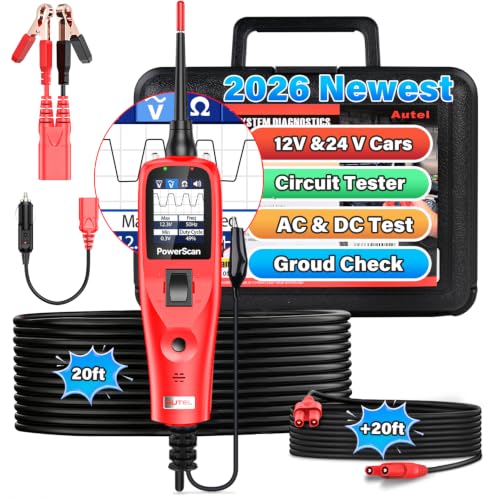
- AC min/max, frequency, and duty cycle
- 20-foot cable plus 20-foot extension
- Continuity and component-activation functions
Best For: Detailed signal checks with extended reach
Best Probe Accessory Kit – VDIAGTOOL V200 Pro Upgrade Kit
Among automotive power probe testers, this V200 Pro upgrade kit stands out for its included 30-piece back-probe set. It combines voltage, resistance, diode, polarity, and continuity checks with wire tracing and component activation.
Best For: DIYers and technicians who regularly test harness connectors, sensors, and fuel injectors.
Pros:
- Includes back-probe pins, piercing probes, test leads, and alligator clips.
- Mode II helps trace wires and locate open connections or broken wires.
- Runs from the vehicle battery or cigarette-lighter socket; includes a 40-foot cable.
Cons:
- The extensive probe kit may be more than occasional voltage checks require.
- Its two operating modes take some familiarization.
Choose this kit when connector access matters as much as circuit diagnosis. Its extra probes make it the more versatile V200 Pro package here.
Best for Signal Analysis – ANCEL PB600 Circuit Tester
The ANCEL PB600 is one of the more feature-rich automotive power probe testers in this group. Its live waveform and digital displays help inspect changing signals, while dedicated functions cover injector pulses, relays, and the battery, cranking, and charging systems.
Best For: Technicians and experienced DIYers who need signal analysis alongside routine circuit tests.
Pros:
- Displays waveforms and measures frequency and duty cycle.
- Includes dedicated injector and 4-pin/5-pin relay testing.
- Checks battery condition, cranking, and charging performance.
- Can apply battery power or ground through the probe tip.
Cons:
- Its broader menu may be unnecessary for basic power-and-ground checks.
- Listed operating range is 8–35V DC, so verify compatibility before testing other systems.
The PB600 makes the most sense when diagnosing intermittent or changing signals is a regular task, rather than an occasional exception.
Best for Wire Tracing – VDIAGTOOL V200 Pro Circuit Tester
For shoppers comparing automotive power probe testers to track down wiring faults, the V200 Pro pairs standard circuit measurements with a separate breaker-finder mode. It can help trace wires and identify open connections or broken conductors without damaging insulation.
Best For: Vehicle owners and technicians troubleshooting wiring across a car, truck, trailer, boat, or RV.
Pros:
- Tests AC/DC voltage, resistance, diodes, polarity, and continuity.
- Breaker-finder mode uses tone changes to help locate wiring faults.
- Includes a 20-foot cord plus a 20-foot extension.
- Supports component activation and has overload shutdown protection.
Cons:
- Switching between probe and breaker-finder modes adds a step.
- No 30-piece back-probe kit is specified for this version.
This is a sensible pick if extended reach and wire tracing are priorities, but you do not need the upgrade kit’s additional probe accessories.
Best for Everyday Checks – ANCEL PB100 Circuit Tester
The ANCEL PB100 covers the everyday jobs buyers expect from automotive power probe testers: checking voltage and polarity, testing continuity, spotting bad grounds, and applying power or ground to compatible components. Red and green LEDs plus audible feedback make quick checks easier to follow.
Best For: DIYers and technicians who want straightforward power, ground, and component checks.
Pros:
- Four modes cover DC voltage, AC voltage, resistance, and diodes.
- Power switch can activate compatible motors, lights, pumps, and relays.
- Polarity LEDs and audible monitoring offer immediate feedback.
- Built-in circuit breaker provides overload protection during appropriate tests.
Cons:
- Supplied notes do not list the PB600’s dedicated waveform, injector, or battery-system modules.
- Always confirm a component is suitable before applying power or ground.
Choose the PB100 for practical 6–30V circuit troubleshooting when dedicated waveform analysis is not on your shopping list.
Classic Circuit Tester – Power Probe III
Among automotive power probe testers, the Power Probe III is a straightforward choice for checking 12–24 VDC circuits and applying power or ground during component tests. Its digital voltmeter, min/max readings, and audible circuit monitoring cover common electrical checks.
Best For: Mechanics who want a dedicated 12–24 VDC circuit tester with power and ground activation.
Pros:
- Supplies power or ground for component testing.
- Digital voltmeter includes min/max readings and audible monitoring.
- Includes a 20-foot cord and battery hookup clips.
Cons:
- Specified for 12–24 VDC systems; AC voltage and resistance modes are not listed.
Choose this one if direct circuit checks and component activation matter more than a broader set of measurement modes.
The Autel PowerScan PS100 suits shoppers comparing automotive power probe testers who want more than a voltage reading. It combines DC and AC voltage modes, resistance checks, polarity indicators, and power or ground activation for 12V and 24V vehicle circuits.
Best For: Technicians and DIY users who want multiple electrical checks and component activation in one probe.
Pros:
- DC voltage display has 0.1V resolution, with LEDs and tones to identify polarity.
- AC mode shows maximum and minimum voltage, frequency, and duty cycle.
- Can apply power or ground to test compatible components and check for poor grounds.
Cons:
- Its listed four modes include a tone on/off setting rather than four separate measurement types.
The PS100 is a useful fit when polarity, signal measurements, and active component checks all have a place in your troubleshooting routine.
The KZYEE KM10 stands out among automotive power probe testers for its color TFT display and live waveform view in AC voltage mode. It also handles DC voltage, resistance, and diode checks, while letting you apply battery power or ground to test compatible components.
Best For: Users who want visible signal changes and enough cable reach to check circuits around a vehicle.
Pros:
- Displays a waveform, frequency, and maximum and minimum voltage in AC mode.
- Provides up to 40 feet of reach with its main cable and extension.
- Includes a work light and an internal circuit breaker for power-output overloads.
Cons:
- Component activation requires checking vehicle wiring diagrams and service procedures.
- Waveform observations still need to be compared with vehicle service information.
Pick the KM10 when a visual signal display and long reach will help you investigate wiring, lighting, or accessible sensor circuits.
Best for Long-Reach Testing – Autel PowerScan Circuit Tester
Among automotive power probe testers, this Autel PowerScan is a practical choice when you need to reach wiring around a vehicle. Its 20-foot cable and included 20-foot extension pair with voltage, polarity, continuity, and resistance checks.
Best For: Diagnosing vehicle circuits when extra cable reach and component activation matter.
Pros:
- Four modes cover DC voltage, AC voltage, resistance, and optional tone alerts.
- Can activate compatible components such as lights, motors, and fans.
- Red and green LEDs help identify positive and negative connections.
Cons:
- Requires a vehicle power connection rather than operating as a standalone meter.
- Applying power during tests calls for care around sensitive circuits.
The long cable setup is its clearest advantage. Choose it if you want one powered probe for basic electrical checks and component testing across a vehicle.
Best for Trailer Wiring – KZYEE KM06 Circuit Tester
The KZYEE KM06 stands out among automotive power probe testers for its built-in wire tracing and stated 8–35V operating range. It combines voltage, polarity, continuity, resistance, and diode checks with component activation for troubleshooting cars, trucks, RVs, and trailers.
Best For: Tracking wiring faults and checking trailer-light circuits across 8–35V vehicles.
Pros:
- Built-in wire tracer helps narrow down shorts, opens, and damaged wiring.
- TFT display, tone alerts, polarity indicators, and LED flashlight aid visibility.
- Includes a 13-foot cable, battery clamps, and an extra probe tip.
Cons:
- The included cable is shorter than the 20-foot cables supplied with the Autel options listed here.
- Component activation should be limited to compatible components.
This is the most direct fit of the three for trailer-light troubleshooting, especially if tracing a wire is more useful to you than having the longest included cable.
Best for Detailed Readouts – Autel PowerScan PS100 2.0
If you want automotive power probe testers that show more than a simple polarity light, consider the Autel PowerScan PS100 2.0. It offers DC and AC voltage, resistance, and tone modes, with AC readings that include minimum and maximum voltage, frequency, and duty cycle.
Best For: Vehicle and trailer-circuit checks that benefit from detailed voltage readings and extended cable reach.
Pros:
- Displays DC voltage to 0.1V resolution and additional AC signal information.
- Supports continuity checks, ground checks, and activation of compatible components.
- Includes a 20-foot cable plus a 20-foot extension.
Cons:
- The tone mode controls audible alerts; it does not add another electrical measurement.
- Powered component tests require care to avoid applying voltage to unsuitable circuits.
The PS100 2.0 is a strong fit when AC signal details and long reach are priorities. Its stated vehicle-system range is 6–30V, so check that against the equipment you plan to test.
How We Picked These Automotive Power Probe Testers
We focused on tools suited to practical vehicle electrical diagnosis: checking power and ground, investigating opens or shorts, and, where supported, applying power or ground to a circuit. We also considered the stated 12V or 12–24V coverage, included accessories, display features, and how clearly each option fits a DIY or workshop use case. Product names alone cannot verify every function or accessory, so check the current listing and manual before buying.
Quick Comparison: Match the Tool to the Job
For basic power-and-ground checks, start with a straightforward probe such as the ANCEL PB100 or KZYEE KM06. If you frequently work on both 12V and 24V vehicles, compare the stated voltage coverage of the ANCEL PB600, V200 Pro, and Autel PowerScan variants. The VDIAGTOOL V200 PRO Upgrade Kit is worth a look when back-probe accessories are a priority. The KZYEE KM10 is the display-focused option in this selection, while the Power Probe 3 is an option for shoppers specifically seeking a tool that supplies power and ground. Check the exact model number: similarly named PowerScan and V200 packages may differ.
Key Buying Factors for Automotive Power Probe Testers
Voltage Range and Circuit Compatibility
Confirm whether the tester supports your vehicle’s nominal 12V or 24V system. That rating does not mean every circuit is safe to energize. Check the tool’s voltage, current, fuse, and duty-cycle limits before applying power or ground, especially around electronic modules, sensors, and low-current control circuits.
Testing Functions and Readability
A voltage reading and clear power/ground indication cover many everyday checks. Polarity indication, continuity testing, short-circuit tracing features, or a waveform display may help with more involved faults, but capabilities vary by model. If you need to inspect fast-changing signals in detail, a dedicated oscilloscope may still be necessary.
Probe Access, Leads, and Protection
Long leads make it easier to reach the rear of a vehicle; a secure battery connection and usable probe tip matter in tight spaces. Back-probe pins can help you access connectors without piercing insulation, provided they fit and are used carefully. Look for replaceable fuses or other stated overload protection, and review what is actually included in the kit.
Who Should Buy Which Automotive Power Probe Testers?
For occasional DIY troubleshooting, prioritize clear readings, simple controls, and a price that suits infrequent use. For frequent 12V and 24V work, prioritize verified voltage coverage, durable leads, and dependable circuit protection. Choose a kit with back-probe accessories if connector access slows you down; consider a waveform-display model if visualizing changing signals is useful. Regardless of model, use a wiring diagram and disconnect sensitive components when the test procedure calls for it. A probe is a diagnostic aid—not a substitute for confirming that a circuit can safely accept externally applied power or ground.