
In today’s world, managing electrical systems efficiently and safely is essential. Whether you’re a DIY enthusiast or a professional, choosing the right digital fuse and relay control modules can make a significant difference in your projects. From customizable timing options to waterproof designs for automotive use, these modules offer various features to enhance performance. Let’s explore the top options available that can streamline your electrical setups and provide peace of mind.
DROK Delay Relay Module (DC 6-30V Timer Relay)
If you’re looking for a versatile timer relay module, the DROK Delay Relay Module (DC 6-30V) is an excellent choice. This compact module operates within a 6-30V range and boasts a timing capability from 0.01 seconds to 9999 minutes, allowing you to customize your timing needs. With a 10 Amp current rating and a maximum switching voltage of 30 Volts, it handles various applications effortlessly. The clear LCD display and easy-to-use controls make setup a breeze. Plus, features like a one-button pause and automatic sleep mode enhance its functionality, ensuring you get the most out of your relay module.
Best For: The DROK Delay Relay Module is best for DIY enthusiasts and professionals looking for a reliable and customizable timer relay solution for various electronic applications.
Pros:
- Versatile Timing Options: Adjustable timing range from 0.01 seconds to 9999 minutes for various applications.
- User-Friendly Interface: Clear LCD display and intuitive controls simplify setup and operation.
- Multiple Triggering Methods: Supports high level, low level, and button trigger control for flexibility in usage.
Cons:
- No Included Cables: Trigger cables or connectors must be purchased separately, which may add to overall costs.
- Limited Voltage Range: Operates only within a 6-30V range, potentially limiting its use in higher voltage applications.
- Surface Mount Only: Requires surface mounting, which may not be suitable for all projects or installations.
Joinfworld Relay Box 12V Automotive Universal Fuse Panel

The Joinfworld Relay Box 12V Automotive Universal Fuse Panel is ideal for automotive enthusiasts who value both safety and ease of installation. With 6-way relays and 14 ATC/ATO blade fuses, this panel provides versatility, featuring relays rated at 40A and fuses ranging from 10A to 40A. You’ll appreciate the pre-assembled relay module that simplifies the installation process, eliminating the need for welding wires. Plus, the LED indicators let you monitor each relay’s status. Built with high-quality nylon and a flame-retardant shell, it’s waterproof and perfect for various vehicles like SUVs, ATVs, and marine boats, ensuring neat wiring.
Best For: Automotive enthusiasts looking for a reliable and easy-to-install fuse panel for various vehicles.
Pros:
- Convenient Installation: Pre-assembled relay module eliminates the need for welding wires.
- Safety Features: LED indicators and overvoltage protection enhance monitoring and reliability.
- Versatile Application: Suitable for a wide range of vehicles including SUVs, ATVs, and marine boats.
Cons:
- Limited Fuse Ratings: Fuses range from 10A to 40A, which may not be suitable for high-power applications.
- Single Voltage Rating: Designed specifically for 12V systems, limiting its use in other voltage setups.
- Potential Size Constraints: May require specific mounting space in vehicles due to its dimensions.
Automation DC 12V Time Delay Relay Module with LED Display
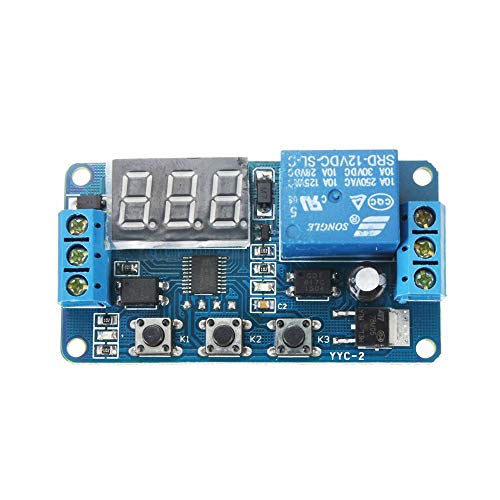
For DIY enthusiasts and professionals looking to enhance their automation projects, the Automation DC 12V Time Delay Relay Module with LED Display stands out as an excellent choice. This module offers adjustable delay times from 0.1 seconds to 999 minutes, making it incredibly versatile. With multiple modes like standard timing and infinite loop, you can easily customize its functionality to fit your needs. It features a screw connector, can handle 10 amps, and is designed for DIN rail mounting. Weighing just 0.81 ounces, it’s compact yet powerful, earning a solid 4.4-star rating from users.
Best For: DIY enthusiasts and professionals seeking a versatile and customizable relay timer for automation projects.
Pros:
- Adjustable delay time ranging from 0.1 seconds to 999 minutes, allowing for flexible applications.
- Multiple working modes provide customization options for various automation needs.
- Compact design and DIN rail mounting capability make installation easy and convenient.
Cons:
- Limited maximum switching voltage of 16 volts may not be suitable for all applications.
- Requires a 12V power supply, which may not be readily available for all users.
- Customer ratings indicate some users may experience issues, as reflected in the 4.4-star average.
UCTRONICS DC 12V Programmable Time Delay Relay Module

One standout feature of the UCTRONICS DC 12V Programmable Time Delay Relay Module is its 18 programmable working modes, making it perfect for both DIY enthusiasts and professional engineers alike. You can easily set delay times from 0.1 seconds to 270 hours, and it automatically saves your settings, even during power outages. With a robust metal enclosure for protection and reverse connection safeguards, it’s built for reliability. Whether you’re working on automobile modifications, LED lights, or electronic control systems, this module’s flexibility and ease of use will enhance your projects, including seamless integration with Raspberry Pi and PLC outputs.
Best For: DIY enthusiasts and professional engineers looking for versatile time delay solutions in their projects.
Pros:
- 18 programmable working modes allow for a wide range of applications and customization.
- Delay time range from 0.1 seconds to 270 hours provides flexibility for various project needs.
- Robust metal enclosure ensures protection and reliability in different environments.
Cons:
- Requires a DC 12V power supply, which may limit compatibility with certain setups.
- Might have a learning curve for users unfamiliar with programmable relay modules.
- Size and weight of the enclosure could be a consideration for compact installations.
2pcs DC 12V Relay Module 4 Channel Relay Board
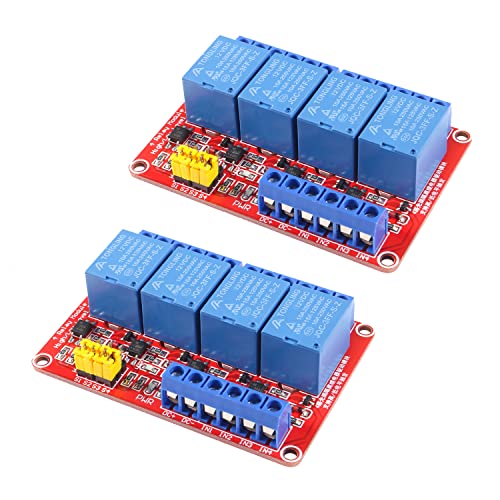
Engineered for hobbyists and professionals alike, the 2pcs DC 12V Relay Module 4 Channel Relay Board stands out with its optocoupler isolation feature, ensuring reliable and stable triggering. You’ll appreciate its fault-tolerant design, which keeps the relay inactive if the control line breaks. With a trigger current of just 5mA and a load capacity of up to 10A for AC and DC applications, this module is perfect for various projects. The standard interface makes it easy to connect with microcontrollers. Its compact size and screw terminal plate facilitate hassle-free mounting, making it a versatile addition to your electrical toolkit.
Best For: Hobbyists and professionals looking for a reliable and versatile relay module for their electronic projects.
Pros:
- Optocoupler isolation ensures stable triggering and enhances safety.
- Compact design with screw terminal plate facilitates easy mounting and connection.
- High load capacity supports up to 10A for both AC and DC applications, making it versatile for different projects.
Cons:
- Requires a 12V power supply, which may limit its use in low-voltage applications.
- Trigger current of 5mA may not be compatible with all microcontrollers without additional circuitry.
- Limited to 4 channels, which may be insufficient for larger projects requiring more relays.
ESP32 WLED LED Strip Light Controller

The ESP32 WLED LED Strip Light Controller stands out as the ideal choice for tech-savvy individuals looking to elevate their lighting experience. With its powerful ESP32 chip and 15A fuse for safety, you can enjoy both performance and peace of mind. The USB-C interface makes firmware upgrades a breeze. You’ll love connecting directly to the WLED app via Wi-Fi, integrating seamlessly with Alexa for smart home functionality. Plus, the built-in microphone syncs lighting with music rhythms. With over 100 customizable modes and energy-efficient features, this controller supports various addressable light strips for unlimited creative potential in your space.
Best For: Tech-savvy individuals seeking a customizable and energy-efficient lighting solution for their smart home.
Pros:
- Direct Wi-Fi connection to the WLED app eliminates the need for additional gateways.
- Compatibility with various addressable light strips allows for extensive DIY options and creative projects.
- Built-in microphone syncs lighting effects with music, enhancing the ambiance of any space.
Cons:
- Requires a stable Wi-Fi connection for optimal performance and control.
- Installation may be complex for those unfamiliar with DIY electronics.
- Limited support documentation may pose challenges for beginners.
UCTRONICS DC 12V Programmable Multifunction Timer Relay Module
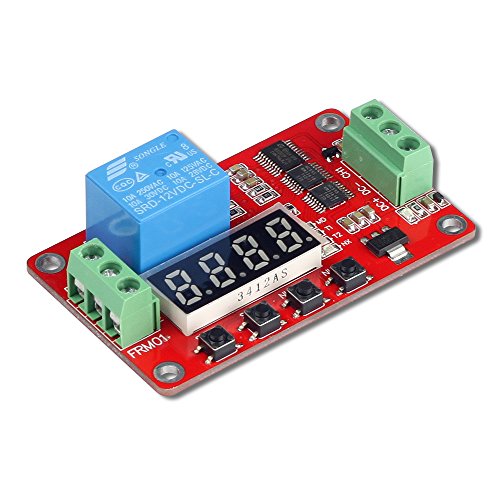
For those who need precise control over timing in their automation projects, the UCTRONICS DC 12V Programmable Multifunction Timer Relay Module stands out with its impressive range of delay options, from a mere 0.1 seconds to an astounding 270 hours. This module offers 18 programmable delay modes, making it perfect for various switching needs. With segment LED displays, it’s user-friendly for smart home applications. Plus, reverse protection prevents damage from incorrect connections, and the auto power-saving function is customizable. All settings are saved, ensuring you won’t lose your configurations during power outages. It’s a reliable choice for automation tasks.
Best For: Individuals and businesses looking for a reliable timer relay for automation projects requiring precise timing control.
Pros:
- Versatile: Offers 18 programmable delay modes suitable for various applications.
- User-Friendly: Equipped with segment LED displays for easy monitoring and configuration.
- Durable: Features reverse protection to safeguard against incorrect terminal connections.
Cons:
- Limited Voltage: Only compatible with a maximum switching voltage of 12V.
- Low Current Rating: Contact current rating is relatively low at 0.01A, which may not support high-power devices.
- DIN Rail Mounting Required: May not be suitable for applications where alternative mounting solutions are preferred.
Waveshare Industrial Modbus RTU 8-Ch Relay Module (D)

Offering extensive control capabilities, the Waveshare Industrial Modbus RTU 8-Ch Relay Module (D) is ideal for industrial applications that require reliable relay management. With a power supply range of 7-36V and a contact rating of up to 10A, you can easily configure device addresses from 1 to 255. The onboard isolation features, including optical and magnetic isolation, guarantee high reliability while protecting against interference. Plus, the module’s flash-on, flash-off function and digital input support enhance its versatility. Its rail-mounted design makes installation straightforward, while status LEDs keep you informed about system activity.
Best For: Industrial applications requiring reliable and configurable relay management with robust isolation features.
Pros:
- High reliability with multiple isolation methods to prevent interference.
- Versatile functionality including flash-on, flash-off, and digital input support.
- Easy installation with a rail-mounted design and clear status indicators.
Cons:
- Limited power supply range of 7-36V may not suit all applications.
- Maximum contact rating of 10A may not meet higher load requirements.
- Requires RS485 communication knowledge for configuration and use.
DC 5-36V Digital LED Relay Board Dual-MOS Timer Delay Module

Designed specifically for versatile control, the DC 5-36V Digital LED Relay Board Dual-MOS Timer Delay Module is perfect for hobbyists and professionals alike. You can effortlessly manage various devices, from DC motors to LED strips, thanks to its robust design. Utilizing Dual-MOS technology, it delivers lower internal resistance and stronger power, ensuring compatibility with most equipment. With features like an emergency stop function and a digital display that turns off after five minutes, it enhances user experience. Plus, its silent operation eliminates sparks and electromagnetic interference, making it an ideal choice for diverse electronic control projects.
Best For: This product is best for hobbyists and professionals seeking reliable control of various electronic devices.
Pros:
- Silent operation eliminates noise and electromagnetic interference, making it suitable for sensitive environments.
- Robust design with Dual-MOS technology ensures strong power output and compatibility with a wide range of equipment.
- User-friendly interface features an emergency stop function and a digital display that conserves energy by turning off after inactivity.
Cons:
- Limited voltage range (5-36V) may not accommodate higher voltage applications.
- Digital display may be less visible in bright lighting conditions.
- Potential learning curve for inexperienced users unfamiliar with digital relay boards.
Nilight 12V Fuse Relay Box with 6 Relays and Waterproof Block Kit

The Nilight 12V Fuse Relay Box stands out as an essential tool for those who need a reliable and organized solution for managing multiple circuits in their vehicles. With six relays and a waterproof design, it keeps your wiring tidy and protected from dust and moisture. The pre-wired setup simplifies installation, making it perfect for cars, trucks, trailers, and marine applications. Each relay supports up to 40 amps, and the included ATC/ATO fuses range from 5 to 30 amps, ensuring versatility. Rated 4.6 stars, it’s a top choice for safety and efficiency in electrical management.
Best For: Those looking for a reliable and organized solution for managing multiple electrical circuits in 12V vehicles such as cars, trucks, trailers, and marine applications.
Pros:
- Waterproof and dustproof design enhances durability and protection for wiring.
- Pre-wired setup simplifies installation and reduces setup time.
- Versatile fuse options (5A to 30A) accommodate various electrical needs.
Cons:
- Limited to 12V applications, which restricts use to specific vehicles.
- Size may be bulky for some installation spaces, potentially complicating fitment.
- Relays may require additional space for proper airflow and heat dissipation.
Factors to Consider When Choosing Digital Fuse and Relay Control Modules
When choosing digital fuse and relay control modules, you need to take into account several key factors. Voltage and current ratings are essential for ensuring compatibility with your system, while the number of channels can affect how many circuits you can control. Don’t forget to look at installation options, safety features, and any programmable modes that might enhance functionality.
Voltage and Current Ratings
Selecting the right digital fuse and relay control module involves paying close attention to voltage and current ratings. Make sure the voltage rating matches your system’s requirements; common options include DC 6-30V and DC 12V for automotive use. The current rating is essential too; while many modules support up to 10 Amps, some designs can handle loads up to 40 Amps. Don’t forget the maximum switching voltage, which usually shouldn’t exceed the specified limit, like 30 Volts for low-voltage relay applications. Additionally, check the minimum switching voltage needed—some modules operate at just 6 Volts, while others might need 12 Volts. Finally, confirm compatibility by reviewing the relay’s load capacity, which varies between AC (e.g., 250V) and DC (e.g., 30V) ratings.
Number of Channels
Choosing the right number of channels in a digital fuse and relay control module can considerably impact your project’s efficiency and flexibility. The number of channels determines how many devices you can control independently, with common options being 4-channel, 6-channel, and 8-channel configurations. More channels provide greater flexibility, allowing you to control multiple devices, such as lights and motors, simultaneously. Each channel typically corresponds to a relay that can switch on or off, making higher counts ideal for complex systems needing various control points. Don’t forget to evaluate the power rating of each channel, as it affects the types of devices you can connect safely. Programmable channels also enhance automation by allowing custom timing and triggering functions for each device.
Installation and Mounting Options
The number of channels you decide on plays a significant role in how you’ll install your digital fuse and relay control module. You’ll want to take into account the mounting type, like surface mount or DIN rail mount, to make sure it fits your installation environment. Look for modules with screw terminal connections, as these provide secure wiring and simplify the assembly process. Pay attention to the module’s dimensions to confirm it fits within the available space in your vehicle or application area. Additionally, features like waterproof covers or enclosures enhance durability against environmental factors. If you prefer ease of installation, think about pre-wired relay box designs to cut down on extra wiring efforts.
Safety Features and Protection
When it comes to digital fuse and relay control modules, considering safety features and protection is essential for ensuring reliable operation. Look for modules equipped with overvoltage and surge protection to guard against electrical spikes that could damage your system. Reverse connection protection is another must-have, preventing circuit failures from incorrect terminal connections. Optocoupler isolation enhances reliability by reducing interference from high-voltage circuits. Built-in resettable fuses and transient voltage suppressors (TVS) help manage over-current and over-voltage conditions, ensuring safe functioning. Additionally, LED indicator lights provide real-time monitoring of working states, letting you quickly spot any operational issues. Prioritizing these safety features will enhance your module’s performance and longevity.
Programmable Modes and Functions
How can you confirm your digital fuse and relay control module meets your specific needs? One key factor is the range of programmable modes available. Look for modules that offer multiple timing configurations, like on/off delays and infinite/finite loops. Adjustable delay times are essential too, with options ranging from 0.01 seconds to several days. This versatility enhances application adaptability. Also, make sure your module includes features like automatic saving of settings and power-off memory to retain configurations during outages. Evaluate trigger options, such as high/low level triggers and button triggers, to improve integration flexibility. Finally, consider models with visual indicators, like LED displays, for real-time monitoring of relay states and operational statuses.
Compatibility With Devices
Choosing the right digital fuse and relay control module hinges on its compatibility with your devices. First, verify the relay operates at the same voltage level as your devices, typically ranging from DC 5V to DC 36V. This avoids compatibility issues. Next, check the load capacity of the relay; it should be rated between 10A to 40A to handle your devices’ current requirements. Look for programmable features like delay and timing settings to enhance compatibility with your specific needs. Also, consider the triggering mechanism supported by the relay module, such as high/low level triggers, as this affects interaction with your devices. Finally, verify the module’s physical dimensions fit your installation space for secure connections.
Material and Build Quality
After confirming compatibility with your devices, the next key factor to contemplate is the material and build quality of the digital fuse and relay control module. High-quality nylon or flame-retardant plastic guarantees durability and safety during operation. Look for robust enclosures featuring waterproofing and tamper-proof designs to protect internal components from environmental factors and mechanical damage. The choice of contact materials, like silver alloy or copper, impacts the conductivity and reliability of electrical connections. Proper insulation techniques, such as optocoupler isolation, are essential to prevent electrical interference. Additionally, consider the module’s weight and dimensions, as they can indicate sturdiness and suitability for various installation environments, influencing performance and ease of setup.