
OBD2 Scanner Diagnostic Tool review for 2026 buyers who want a straightforward way to read codes, check live data, and clear common warning lights.
It is aimed at drivers and DIY mechanics who need more than a bare-bones code reader.
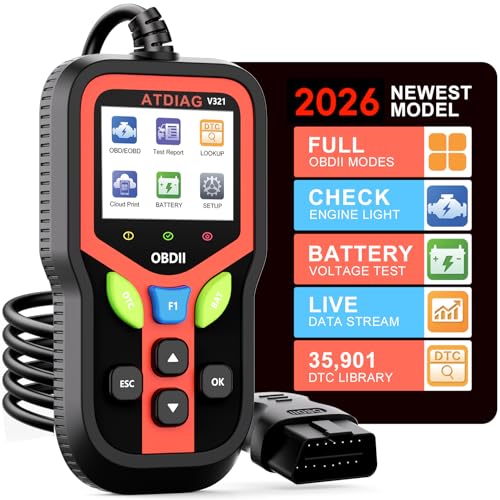
OBD2 Scanner Diagnostic Tool Review Summary
If your priority is to diagnose a check engine light without jumping into a complicated shop-level workflow, this OBD2 Scanner Diagnostic Tool is built around that exact job.
It combines core fault-code reading and clearing with live sensor data, I/M readiness, EVAP testing, freeze frame access, battery checks, and cloud-based report printing, so it fits drivers who want a broader picture of vehicle health in one handheld tool.
The strongest case for this product is not novelty; it is coverage.
The listing positions it as a plug-and-play scanner for most OBDII vehicles since 1996 in the US, 2000 in Europe, and 2008 in Asia, and it adds practical touches like a 2.4-inch color display, 10-language support, shortcut keys, and a rugged silicone case.
That makes it most appealing to owners who want fast answers, simple operation, and enough depth to move beyond a basic code pull.
Review Scorecard
| Category | Score | Buyer-focused rationale |
|---|---|---|
| Fault-code handling | 9/10 | Reads and clears trouble codes and includes a large built-in fault-code library. |
| Live diagnostics | 8/10 | Shows real-time sensor data such as RPM, coolant temperature, and fuel pressure. |
| Ease of use | 8/10 | Plug-and-play operation, shortcut keys, and a color screen reduce friction. |
| Vehicle coverage | 8/10 | Broad OBDII compatibility across many gas-powered vehicles by model year. |
| Extra utilities | 8/10 | Adds battery testing, EVAP tests, freeze frame, and cloud printing. |
| Durability | 7/10 | Rugged case and insulated cable suggest workshop-friendly build quality. |
In plain terms, this is a sensible choice if you want a scanner that can help you decide whether a warning light is minor, recurring, or worth immediate attention.
It is less about flashy software and more about giving you a fuller diagnostic snapshot from the car itself.
That balance is useful for both new DIY owners and people who already know the basics but want a more capable handheld scanner.
Key Features and Specifications of OBD2 Scanner Diagnostic Tool
The product is centered on standard OBDII diagnostics.
According to the listing, it can read and clear trouble codes, check I/M readiness, show live sensor data, run EVAP tests, check battery health, and display freeze frame data.
It also includes a built-in library covering more than 35,901 fault codes, which is a meaningful advantage over basic scanners that only show the code number and little else.
Compatibility is broad for the intended use case.
The scanner is listed for most cars manufactured after 1996 in the US, after 2000 in Europe, and after 2008 in Asia, provided the vehicle has a standard 16-pin OBD2 port.
That still means buyers should verify compatibility before purchase, especially if they are working with an unusual vehicle or need brand-specific advanced functions.
Other practical details matter here too:
- 2.4-inch color display
- 10-language support, including English, Spanish, French, and Portuguese
- Shortcut keys for quick access to reports, DTC reading, and battery testing
- Tri-color indicator lights for fast status feedback
- Cloud-based QR code printing for saving or sharing reports
- 3.0-foot insulated cable
- Rugged silicone case
- Rated for operation in temperatures from -22°F to 158°F
- Supports vehicle diagnostics for up to 24 hours
The listing also frames it as easy to use: connect it, turn the key, and start diagnosing.
That simplicity is important because many buyers do not want an app-dependent setup or a learning curve just to understand a warning light.
This product leans into self-contained convenience rather than smartphone pairing or advanced tuning features.
Pros and Cons of OBD2 Scanner Diagnostic Tool
Pros
- Reads and clears codes without requiring extra software.
- Covers more than just codes by adding live data, freeze frame, EVAP, and battery testing.
- Large built-in code library should help with interpretation.
- Color screen and shortcut keys make the workflow faster.
- Broad vehicle compatibility is useful for common family cars and commuter vehicles.
- Cloud printing can make it easier to save or share results.
Cons
- The listing does not suggest advanced manufacturer-specific diagnostics.
- Compatibility still needs to be checked before buying.
- It appears aimed more at general diagnostics than deep professional-level repair workflows.
- The core value is practical coverage, not a premium interface or app ecosystem.
The main tradeoff is clear: this is a feature-rich general-purpose scanner, but not a dedicated pro diagnostic platform.
For many buyers, that is exactly the right position.
You get enough diagnostic depth to be useful, without paying for capabilities you may never use.
Who Should Buy OBD2 Scanner Diagnostic Tool?
This scanner makes the most sense for drivers who want to understand warning lights quickly and avoid guessing.
If you handle routine maintenance yourself, it can help you confirm whether a fault is likely sensor-related, readiness-related, battery-related, or something that needs a shop visit.
It is also a good fit for households with more than one compatible vehicle.
Because the listing emphasizes wide OBDII support and easy operation, it can serve as a shared diagnostic tool instead of a one-vehicle specialty gadget.
That matters if you want one scanner that can live in the glove box, garage, or tool drawer and be ready when a light comes on.
This product is likely less appealing if you need brand-specific coding, advanced module access, or a highly specialized professional interface.
If that is your situation, you should look at more advanced scan tools instead.
If all you need is reliable engine-code diagnosis, live data, and practical status checks, this is much easier to justify.
How the OBD2 Scanner Diagnostic Tool Handles Everyday Diagnosis
Reading the First Clue
The most important job for any scanner is the first pass: what triggered the light, and what else was happening when it appeared.
The freeze frame function helps here by preserving the vehicle snapshot around the fault, which is more useful than a bare code number alone.
Checking Whether the Car Is Ready
I/M readiness is one of the most overlooked features in basic scanners.
It helps you see whether the vehicle has completed the monitors needed for emissions-related checks, which is useful after repairs, a battery disconnect, or code clearing.
Looking Beyond the Code
Live data is where this scanner becomes more useful than a very basic reader.
The listing specifically mentions RPM, coolant temperature, and fuel pressure, and those are exactly the kinds of readings that help you decide whether a problem is intermittent, heat-related, or tied to a sensor or fuel issue.
Saving or Sharing the Result
Cloud-based QR code printing gives the tool a practical record-keeping angle.
That is helpful if you want to save the report for later, send the result to someone helping you diagnose the issue, or keep notes before a repair appointment.
Alternatives to OBD2 Scanner Diagnostic Tool
If you want a comparable handheld scanner with broad consumer recognition, consider a FIXD OBD2 scanner.
It is the kind of product buyers often compare when they want simple code reading and plain-language guidance.
If you want a more established repair-focused brand, look at BlueDriver OBD2 scanner.
It is a common alternative for buyers who want a more polished diagnostic workflow and are willing to compare app-based features.
If you prefer a traditional handheld tool from a widely sold diagnostic brand, compare against Autel OBD2 scanner.
That line is often attractive to shoppers who want a broader scanner ecosystem and more upgrade paths.
If you want a simple budget-style code reader, search for INNOVA OBD2 scanner.
It is a reasonable comparison point for buyers focused on basic diagnostics rather than specialized functions.
Is OBD2 Scanner Diagnostic Tool Worth It?
Yes, if you want a practical, easy-to-use scanner that goes beyond the cheapest code readers without turning into a complex professional tool.
The combination of code reading and clearing, live data, freeze frame, battery testing, I/M readiness, EVAP tests, and cloud report saving gives it solid real-world utility.
It is especially worth considering for everyday drivers, home mechanics, and anyone who wants a compact diagnostic tool that can help with fast decisions.
If you need deep brand-level module access or advanced shop-grade functions, look elsewhere.
If your goal is confident, readable, all-around OBDII diagnostics, this one is a sensible buy.