
Choosing the right transmission jack can make drivetrain removal and installation safer, faster, and more controlled. The best model depends on your typical transmission weight, vehicle lift height, available floor space, and how precisely your technicians need to position a load.
We compared 10 hydraulic and telescoping options across capacity, lifting range, saddle adjustability, mobility, and workshop practicality to help you select a jack that fits your service bay.
Best 10 Transmission Jacks for Professional Workshops Picks for 2026
Best Foot-Pump Telescopic Jack

- 1,000-lb capacity with 74-inch maximum height
- Foot-operated hydraulic pump
- Tilt saddle, strap, and overload valve
Best For: Car-focused shops needing tall, hands-free lifting
Best Low-Profile Heavy-Duty Jack

- 2,200-lb capacity and 8-1/4-inch minimum height
- Swiveling handle for restricted spaces
- Includes Eaton Fuller RoadRanger adapter
Best For: Heavy-duty truck and low-clearance service
Best Tall Adjustable Workshop Jack

- 1,660-lb capacity with 72-inch maximum height
- Foot pedal and slow-release descent
- 30-degree adjustable saddle with swivel casters
Best For: General garages servicing cars and light trucks
Best High-Capacity Low-Profile Jack

- 4,000-lb capacity for heavy components
- 9.57-to-34-inch lift range
- 30-degree saddle adjustment and swivel casters
Best For: Shops handling heavy transmission and drivetrain service
High-Lift Shop Pick
OTC TJH10 1,000 lb. Transmission Jack

- 71-5/8-inch maximum lift
- Tilting saddle with adjustable brackets
- Foot controls and safety chains
Best For: Automotive shops needing high vertical reach
Heavy-Duty Low-Profile Choice
AFF 4,400 lb. Manual Transmission Jack

- 4,400-pound load capacity
- Low 8-1/2-inch starting height
- Wishbone design with adjustable saddle
Best For: Heavy truck, bus, and construction-equipment driveline work
Telescoping SUV Specialist
OEMTOOLS 26842 1-Ton High-Lift Jack
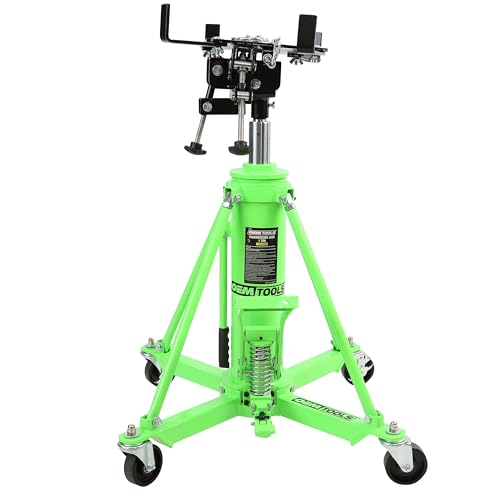
- 37.5- to 76-inch lift range
- Two-stage hydraulic system
- Foot controls and adjustable saddle fingers
Best For: Truck and SUV transmission service
Low-Profile Heavy-Duty Pick
2000 lb Adjustable Hydraulic Transmission Jack

- 2,000-pound load capacity
- 6.9-inch low starting height
- Telescoping lift with swivel casters
Best For: Professional shops prioritizing capacity and low vehicle access
Fast High-Lift Choice
Dual Plunger Hydraulic Transmission Jack
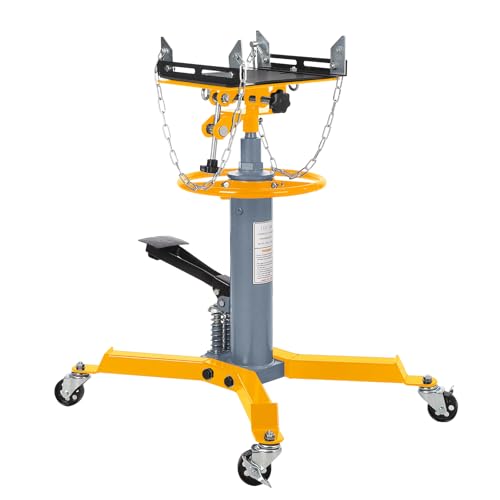
- 33.5- to 69-inch lift range
- Dual plunger reaches height quickly
- Tilting tray and safety chains
Best For: Lift-equipped shops needing fast, high-reaching operation
Balanced Shop Workhorse
VEVOR 1322 lb Hydraulic Transmission Jack

- 1,322-pound capacity
- 32- to 68.5-inch hydraulic lift
- 30° adjustable saddle with braked wheels
Best For: General car and light-truck transmission service
Best Foot-Pump Telescopic Jack – Sunex Tools 7793B
For professional workshops needing transmission jacks for professional workshops, the Sunex Tools 7793B combines a foot-operated hydraulic pump with a telescoping lift and tilt saddle. Its 1,000-pound capacity suits car transmission service, while the included nylon strap and overload valve add useful load-control features.
Best For: Car-focused repair shops that value hands-free lifting and substantial working height.
Pros:
- Foot pedal allows hands-free raising.
- Reaches a maximum height of 74 inches.
- Tilt saddle, nylon tie-down strap, and overload valve support controlled service.
- Telescopic rams can lower the transmission onto a work table.
Cons:
- Its 1,000-pound capacity is lower than the heavy-duty options in this roundup.
- At 163.4 pounds, it is substantial to move.
- Its 35-inch minimum height may not suit low-clearance applications.
The 7793B is a practical choice when technicians want a tall, foot-operated jack for car work. Confirm that its capacity and minimum height match the transmissions and vehicles in your shop.
Best Low-Profile Heavy-Duty Jack – OTC 5019A
The OTC 5019A stands out among transmission jacks for professional workshops with its 8-1/4-inch roll-under height and 2,200-pound capacity. A swiveling pump handle helps in restricted spaces, while the included adapter is designed for popular Eaton Fuller RoadRanger transmissions.
Best For: Heavy-duty truck shops servicing low-clearance vehicles and Eaton Fuller-equipped drivetrains.
Pros:
- Very low 8-1/4-inch minimum height.
- 2,200-pound load capacity supports heavy-duty service.
- Swiveling pump handle works in confined areas.
- Included adapter fits Eaton Fuller RoadRanger transmissions.
Cons:
- Optional adapters for other transmissions are sold separately.
- Its 280-pound weight makes repositioning more demanding.
- The listed maximum height is 36-1/2 inches.
With its low profile, truck-oriented adapter, and adjustable tilt range, the 5019A is particularly well matched to heavy-duty repair environments. It is less compelling if your work is limited to ordinary passenger cars.
Best Tall Adjustable Workshop Jack – 35-72-Inch Hydraulic Jack
This 1,660-pound hydraulic model is one of the more flexible transmission jacks for professional workshops, offering foot-pedal adjustment from 35 to 72 inches. Its 30-degree adjustable saddle, slow-release descent, and four swivel casters are aimed at controlled positioning during car and light-truck repairs.
Best For: General garages that need a tall lift range and easy rolling between vehicles.
Pros:
- Foot-operated hydraulic lifting avoids manual pumping.
- 35-to-72-inch height range accommodates varied working positions.
- Adjustable saddle tilts up to 30 degrees.
- Four swivel casters support workshop mobility.
Cons:
- Capacity is below the 2,200- and 4,000-pound alternatives.
- The stated warranty is 90 days from purchase.
- Its 35-inch minimum height is not a low-profile option.
This jack offers a useful balance of reach, maneuverability, and adjustment for mixed car and light-truck work. Its relatively short warranty and higher minimum height should be weighed before equipping a demanding shop.
Best High-Capacity Low-Profile Jack – 4,000-Lb Hydraulic Jack
For demanding transmission jacks for professional workshops applications, this hydraulic model provides a 4,000-pound capacity and a 9.57-to-34-inch lift range. Its heavy-duty steel construction, 30-degree adjustable saddle, and four swivel casters support transmission, gearbox, clutch, and drivetrain positioning.
Best For: Repair shops handling heavy components across cars, trucks, SUVs, and other listed vehicle types.
Pros:
- Highest stated capacity in this selection at 4,000 pounds.
- Low 9.57-inch starting height suits under-vehicle work.
- Adjustable saddle tilts up to 30 degrees for alignment.
- Four swivel casters aid workshop positioning.
Cons:
- Its 34-inch maximum height is lower than the taller jacks here.
- At 163.1 pounds, it is not especially light.
- The supplied details list a six-month warranty.
The 4,000-pound rating makes this the strongest choice for shops that regularly position heavier transmissions or drivetrain components. Its modest maximum height favors floor-level service rather than high lifting.
High-Lift Shop Pick – OTC TJH10 1,000 lb. Transmission Jack
For professional workshops that need transmission jacks for professional workshops with substantial lift range, the OTC TJH10 combines a 1,000-pound capacity with a high 71-5/8-inch maximum height. Its tilting head, adjustable brackets, and foot controls support more controlled removal and installation work.
Best For: Automotive shops handling car, truck, SUV, van, bus, or RV transmission and driveline service.
Pros:
- High-lift range from 35 to 71-5/8 inches.
- Tilting universal saddle, adjustable corner brackets, and safety chains help position and secure loads.
- Wide 37-1/8-inch leg base, four steel swivel wheels, and an overload safety system support shop use.
- Foot-operated pump and lowering pedal allow hands-free control.
Cons:
- Its 1,000-pound capacity is intended for automobile transmissions rather than the largest heavy-equipment units.
- The 35-inch minimum height may not suit very low-clearance applications.
The OTC TJH10 is a practical choice when vertical reach and positioning control matter more than maximum load capacity. Flash-chromed rams and ASME PASE-2019 compliance add useful durability and safety credentials for a professional bay.
Heavy-Duty Low-Profile Choice – AFF 4,400 lb. Manual Transmission Jack
Among transmission jacks for professional workshops, the AFF-3180A stands out for its 4,400-pound capacity and 8-1/2-inch low height. The wishbone design, adjustable saddle, and industrial casters make it suited to moving large transmissions, transfer cases, and differentials.
Best For: Workshops servicing large transmissions and driveline components on trucks, buses, and construction equipment.
Pros:
- 4,400-pound capacity handles substantially heavier loads than the other listed options.
- 8-1/2-inch low-profile height provides clearance for low-profile applications.
- Adjustable saddle, tilting capability, safety chain, and four grab handles aid positioning.
- Heavy-duty steel construction and industrial-grade casters support transport around the shop.
Cons:
- At approximately 297 pounds, it is substantially heavier than the lighter-duty alternatives.
- Its listed maximum height is 34 inches, limiting high-reach applications.
The AFF-3180A is the strongest fit for professional facilities prioritizing load capacity and low access height. Its manual hydraulic design and long rotating handle offer practical control, but its bulk is worth accounting for when planning shop movement and storage.
Telescoping SUV Specialist – OEMTOOLS 26842 1-Ton High-Lift Jack
For transmission jacks for professional workshops serving mixed vehicle fleets, the OEMTOOLS 26842 offers a two-stage telescoping lift from 37.5 to 76 inches. Foot-operated controls and an independently adjustable two-way saddle help technicians manage alignment during transmission installation.
Best For: Shops working on transmissions in cars, trucks, and SUVs, especially applications requiring high lift.
Pros:
- 76-inch maximum height accommodates lifted trucks and SUVs.
- Two-stage hydraulic operation is designed for steady lifting and lowering.
- Foot pump and release pedals keep both hands available for positioning.
- Adjustable saddle fingers help stabilize and align transmissions.
Cons:
- The 37.5-inch minimum height is higher than the AFF jack’s low-profile starting height.
- Its 1-ton capacity is not intended for the largest heavy-equipment transmissions.
The OEMTOOLS 26842 is a focused high-lift option for shops that regularly service taller vehicles. Its 193-pound steel construction is heavier than the OTC model, but the extra reach and two-stage telescoping design can be valuable for truck and SUV work.
Low-Profile Heavy-Duty Pick – 2000 lb Adjustable Hydraulic Transmission Jack
For professional workshops comparing transmission jacks for professional workshops, this 2,000-pound hydraulic model emphasizes low vehicle access, precise positioning, and a reinforced steel build. Its 6.9-inch minimum height is useful when working beneath vehicles on lifts or jack stands.
Best For: Shops needing a high-capacity, low-profile jack for repeated transmission removal and installation work.
Pros:
- 2,000-pound load capacity supports demanding transmission service applications.
- Low 6.9-inch starting height fits beneath vehicles with limited ground clearance.
- Multi-stage telescoping lift reaches 31.7 inches for controlled alignment and lowering.
- 360° swivel front casters and a wide base improve shop maneuverability and stability.
Cons:
- Its heavy-duty steel construction may make the unit bulky to handle and store.
- The listed manufacturer warranty is limited to 90 days.
- Shipment should be inspected carefully for damage or missing parts upon arrival.
This is the strongest capacity option in the group and the most appealing choice when low-profile access matters. Confirm that its 31.7-inch maximum height suits your lift and vehicle setup.
Fast High-Lift Choice – Dual Plunger Hydraulic Transmission Jack
This dual-plunger model is designed for professional workshops comparing transmission jacks for professional workshops that value fast lifting and an extended height range. Its foot pedal, tilting tray, safety chains, and braked swivel casters support controlled transmission handling.
Best For: Workshops that need a fast, high-reaching jack for transmissions and transfer cases on lifted vehicles.
Pros:
- Dual plungers are designed to reach maximum height in about 20 seconds.
- Two-stage telescoping adjustment spans 33.5 to 69 inches.
- Foot-operated control supports precise, slow lowering during positioning.
- Includes a 30° tilting tray, non-slip pad, safety anchor chains, and two braked swivel casters.
Cons:
- Its 1,322-pound capacity is lower than the 2,000-pound option in this roundup.
- The 33.5-inch minimum height is not intended for low-clearance access.
- At 97 pounds, it is a substantial piece of shop equipment.
With the tallest listed lift range and a two-year warranty, this jack is geared toward efficient work on elevated vehicles. Its high minimum height makes it best suited to lifts rather than low-floor access.
Balanced Shop Workhorse – VEVOR 1322 lb Hydraulic Transmission Jack
For shops seeking transmission jacks for professional workshops, this VEVOR model combines a 1,322-pound capacity with foot-pedal hydraulic control and a broad 32- to 68.5-inch lift range. Its adjustable saddle and locking casters are aimed at stable work on cars and light trucks.
Best For: General automotive workshops that want a versatile jack for most car and light-truck transmission service.
Pros:
- Supports up to 1,322 pounds for most car and light-truck transmissions.
- Foot pedal provides smooth height adjustment, with a maximum lift of 68.5 inches.
- Adjustable saddle tilts up to 30° to accommodate different transmission shapes.
- Four swivel wheels, including two with brakes, aid movement and positioning.
Cons:
- Its 32-inch minimum height is less suitable for low-clearance applications.
- It has less capacity than the 2,000-pound jack in this comparison.
- The base must be installed in the correct direction to maintain proper wheel rotation.
This is a practical middle-ground option, offering high lift, saddle adjustability, and mobile positioning without the lowest-profile design. It fits workshops servicing a range of standard automotive and light-truck applications.
How We Picked These Transmission Jacks for Professional Workshops
We focused on features that matter during repeated drivetrain service rather than relying on capacity alone. Our comparison considers rated load limits, low and maximum lift heights, hydraulic operation, saddle or adapter adjustability, caster design, footprint, and the presence of restraints or tie-down points. A useful transmission jack should support the load securely while allowing technicians to make controlled height and angle adjustments.
Capacity ratings are treated as working limits, not targets. Choose a model with meaningful reserve capacity for the transmissions, transfer cases, and accessories your shop handles, and always follow the manufacturer’s operating and safety instructions.
Quick Comparison
- Compact low-profile models: Best for vehicles with limited underbody clearance and service bays using low-rise lifts.
- High-lift models: Better suited to two-post lifts, taller vehicles, and installations requiring substantial vertical reach.
- 1,000- to 1,660-pound jacks: Practical for common passenger vehicles and light-duty drivetrain work.
- 2,000- to 4,400-pound jacks: Appropriate when heavier transmissions, transfer cases, or commercial applications are part of the workload.
- Telescoping and dual-stage designs: Offer broader height ranges, but inspect hydraulic components and locking or stabilization features carefully.
Key Buying Factors for Transmission Jacks for Professional Workshops
Capacity and Stability
Select a rating comfortably above your heaviest expected load. A wide base, stable casters, a secure saddle, and chain tie-downs can be as important as the headline capacity, particularly when positioning an angled transmission.
Lift Range and Clearance
Check both the minimum and maximum height against your lifts and vehicles. Low-profile clearance helps with floor-level work, while high-lift reach is essential when the vehicle is elevated. Confirm that the jack’s fully raised height does not interfere with the chassis or lift structure.
Adjustment and Control
Look for tilt adjustment, a swiveling or adaptable saddle, and a foot-operated pump that leaves both hands available for alignment. Smooth hydraulic control helps prevent sudden movement during installation.
Mobility and Maintenance
Swivel casters improve positioning, but they should roll smoothly under load and resist excessive play. For daily use, favor accessible hydraulic components, durable steel construction, replaceable seals or parts where available, and a design that can be stored without blocking walkways.
Who Should Buy Which Transmission Jacks for Professional Workshops?
Choose a low-profile jack if your shop regularly services vehicles with limited clearance. Choose a high-lift telescoping model for work on raised vehicles or when installation height varies widely. A mid-capacity 1,000- to 2,000-pound unit is a sensible all-around choice for general repair shops, while heavy-duty 4,000-pound-class equipment is better for shops handling larger drivetrains or needing substantial safety margin. If precise alignment is a priority, prioritize tilt, swivel, and saddle adjustment over maximum lift alone.