
The best rotary tools make detailed work faster, cleaner, and more versatile. From light crafting and 3D-print finishing to sanding, engraving, polishing, and small repairs, the right kit can replace several single-purpose tools.
We compared 10 popular corded and cordless options across power, speed control, accessories, ergonomics, and flexibility to help you choose a rotary tool that fits your projects and workspace.
Best 10 Rotary Tools Picks for 2026
Best Overall Performance
Dremel 4000-2/32 Rotary Tool Kit

- 1.6-amp motor with 5,000–35,000 RPM
- Electronic speed control and airflow ventilation
- Includes two attachments and 32 accessories
Best For: Extended DIY projects requiring versatile corded power
Best Cordless Option
Milwaukee 12V Cordless Rotary Tool

- Cordless 12V design for portable use
- Lightweight 1.3-pound compact body
- 5,000–32,000 RPM variable-speed range
Best For: Mobile cutting, grinding, sanding, and polishing
Best Premium Kit
Dremel 4300-5/40 Rotary Tool Kit
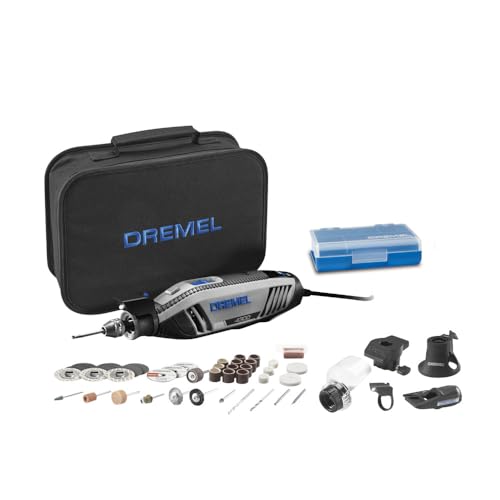
- Includes five attachments and 40 accessories
- Universal three-jaw chuck accepts Dremel shank sizes
- Pivot light and electronic speed control
Best For: Detailed workshop projects and broad accessory compatibility
Best Budget Starter Kit
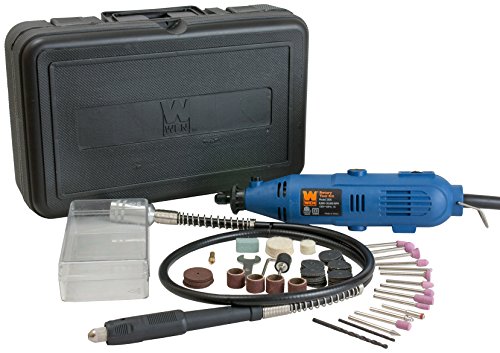
- Includes an 80-piece accessory set
- Flex shaft for intricate detail work
- 8,000–30,000 RPM variable-speed motor
Best For: Beginners seeking an affordable, versatile corded kit
Best Cordless Upgrade

- Five speeds from 5,000 to 25,000 RPM
- Cordless design with 3,000mAh battery
- 55 accessories with organized magnetic storage
Best For: Portable DIY, crafts, and detailed finishing
Best High-Power Value

- 180W motor with speeds up to 32,000 RPM
- Six variable-speed settings
- 139-piece accessory kit and flexible shaft
Best For: Workshop projects and extended corded use
Best for Beginners
HARDELL Mini Cordless Rotary Tool

- Five speeds from 5,000 to 18,000 RPM
- Lightweight cordless pen-style design
- 69-piece kit with LED work lighting
Best For: Light crafts, resin work, and model finishing
Best with Extra Features

- Cordless 12V operation with a 2.0Ah battery
- Five speeds from 7,500 to 32,000 RPM
- Includes 114 accessories and a storage bag
Best For: Portable DIY crafting, repairs, and hobby work
Best Flex-Shaft Kit

- 42-inch flex shaft for detailed control
- Six speeds from 8,000 to 35,000 RPM
- 129 accessories with four collets
Best For: Detailed carving, engraving, polishing, and DIY projects
Best High-Power Option
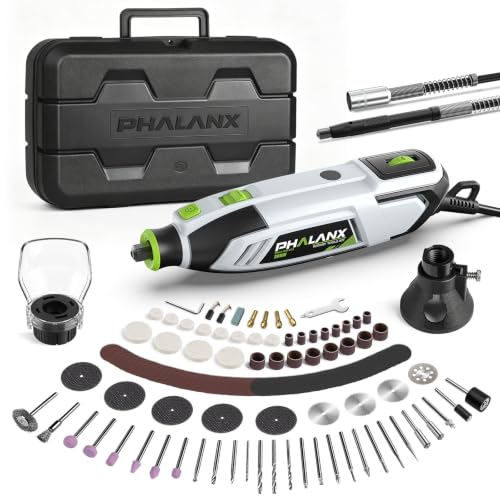
- 200W motor reaching 38,000 RPM
- Keyless chuck and four compatible collets
- 132-piece accessory kit with comfort-grip design
Best For: Power-focused DIY cutting, carving, grinding, and polishing
Best Overall Performance – Dremel 4000-2/32 Rotary Tool Kit
For demanding rotary tools work, the Dremel 4000 combines a 1.6-amp corded motor with electronic speed control from 5,000 to 35,000 RPM. Its ergonomic grip, airflow system, two attachments, and 32 accessories support cutting, sanding, engraving, polishing, grinding, and more.
Best For: DIYers who want a powerful, versatile corded rotary tool for extended projects.
Pros:
- High-performance 1.6-amp motor with consistent speed under load.
- Wide 5,000–35,000 RPM range for varied applications.
- Includes two attachments and 32 accessories.
- Ergonomic 360-degree grip zone and airflow ventilation support longer sessions.
Cons:
- Corded design requires access to a 120-volt outlet.
- At 3 pounds, it is heavier than some compact rotary tools.
The 4000 is a strong all-around choice when sustained power and broad accessory compatibility matter more than cordless portability.
Best Cordless Option – Milwaukee 12V Cordless Rotary Tool
This Milwaukee rotary tool brings cordless convenience to cutting, grinding, sanding, and polishing. The compact 12-volt design weighs 1.3 pounds, reaches 32,000 RPM, and uses a standard 1/8-inch collet for compatibility with current rotary tool accessories.
Best For: Users who prioritize portability and a lightweight tool for work away from outlets.
Pros:
- Cordless 12-volt design improves mobility.
- Compact 9.5-inch body weighs just 1.3 pounds.
- Variable speed from 5,000 to 32,000 RPM.
- Protected front bearing and grinder-style exhaust ports are designed for durability.
Cons:
- Its maximum speed is lower than the 35,000 RPM offered by some corded models.
- Only a wrench, guide, cutting wheel, and mandrel are listed as included components.
- Requires a lithium-ion battery, which may limit use if it needs recharging.
The Milwaukee is a practical pick for mobile projects, especially when a compact, cordless rotary tool is more useful than a large accessory bundle.
Best Premium Kit – Dremel 4300-5/40 Rotary Tool Kit
The Dremel 4300 is a feature-rich choice among rotary tools, pairing a high-performance corded motor with 5,000–35,000 RPM electronic speed control. Its universal three-jaw chuck, pivot light, five attachments, and 40 accessories make it ready for a wide range of detailed projects.
Best For: Makers and DIYers who want a comprehensive kit for woodworking, engraving, cutting, sharpening, and detail work.
Pros:
- Includes five attachments, 40 accessories, and a storage case.
- Universal three-jaw chuck accepts all Dremel accessory shank sizes.
- Pivot light helps illuminate hard-to-reach work areas.
- Replaceable brushes and airflow ventilation support long-term use.
Cons:
- Corded design limits use to locations with a suitable outlet.
- Its broad feature set may be more than needed for occasional basic tasks.
Choose the 4300 when accessory variety, lighting, and compatibility are priorities. It is particularly well suited to users building a versatile workshop setup.
Best Budget Starter Kit – WEN 2305 Rotary Tool Kit
The WEN 2305 offers an accessible way to handle cutting, sanding, polishing, shaping, drilling, deburring, and grinding. Its variable-speed motor reaches 30,000 RPM, while the included 80-piece accessory set and flex shaft add versatility for detailed work.
Best For: Beginners and budget-minded DIYers who want many accessories and flexible detail control.
Pros:
- Includes an 80-piece accessory set for varied applications.
- Flex shaft supports intricate and precision work.
- Variable speed adjusts from 8,000 to 30,000 RPM.
- Onboard spindle lock enables quicker bit changes.
Cons:
- Its 8,000 RPM minimum is higher than some competing rotary tools.
- The one-year limited warranty is shorter than the warranties listed for some alternatives.
- Corded operation requires a 120-volt outlet.
The WEN 2305 stands out as a practical starter package: it provides a large accessory selection and flex-shaft reach without requiring a more specialized setup.
Best Cordless Upgrade – Fanttik F2 PRO Rotary Tool
The Fanttik F2 PRO is a compact cordless option for rotary tools buyers who want adjustable speed, portable handling, and a well-organized accessory system. Its five speed settings span 5,000 to 25,000 RPM, supporting tasks such as deburring, polishing, engraving, sanding, and cutting plastic, wood, or soft metal.
Best For: Portable DIY projects, 3D-printed model finishing, crafts, and detailed repair work.
Pros:
- Cordless 3,000mAh battery supports approximately 20 to 120 minutes of use, depending on speed and material.
- Five speed settings and a high-efficiency magnetic motor provide control for varied tasks.
- Includes 55 accessories, an aluminum alloy case, magnetic rotating holder, and front LED lighting.
- Compact 220 g design and pressure-sensitive switch help reduce hand fatigue.
Cons:
- Its stated use is best suited to DIY, crafts, and soft-material work rather than heavy-duty applications.
- Battery runtime varies considerably with the selected speed and material.
The F2 PRO stands out when portability and organization matter as much as speed control. The RevoStor Hub, battery indicator, and LED lighting add convenience for hands-on projects, while the 25,000 RPM maximum gives it useful flexibility for detailed work.
Best High-Power Value – PHALANX 180W Rotary Tool Kit
The PHALANX 180W kit is a corded choice for rotary tools shoppers who need higher power and a broad accessory selection. Its six-speed adjustment covers 8,000 to 32,000 RPM, while the included flexible shaft can make pen-style detail work and corner polishing easier.
Best For: Extended workshop use, cutting, drilling, engraving, grinding, sanding, and polishing.
Pros:
- 180W motor and 32,000 RPM maximum provide a wide working range.
- Six speed settings help match output to different materials and applications.
- 139-piece accessory kit includes multiple collets, cutting discs, sanding pieces, brushes, burrs, and drill bits.
- Flexible shaft, ventilation openings, and a gear-protection blocker add versatility and usability.
Cons:
- The corded AC design is less portable than the cordless alternatives.
- The chuck must be tightened with a spanner before use.
- The extensive accessory set may be more than casual users need.
Choose this kit if motor output, accessory variety, and flexible-shaft control are priorities. Its corded format suits a fixed workbench, and the broad speed range covers both aggressive material removal and more controlled polishing or engraving.
Best for Beginners – HARDELL Mini Cordless Rotary Tool
The HARDELL Mini Cordless Rotary Tool is designed for approachable, fine-detail work. This lightweight rotary tools kit includes 69 accessories, five speed settings from 5,000 to 18,000 RPM, and an LED designed to improve visibility when sanding resin, 3D prints, wood, or other small projects.
Best For: Beginners, resin crafts, 3D-printed model finishing, light carving, sanding, and polishing.
Pros:
- Lightweight, pen-like design supports precise handling and comfortable detail work.
- Five speed settings make it easier to adjust power for staged sanding and delicate tasks.
- Includes 69 accessories and three collets for a variety of small DIY applications.
- Rechargeable 3.7V battery offers up to 200 minutes of continuous use according to the supplied notes.
Cons:
- It is explicitly not intended for heavy-duty projects.
- Its 18,000 RPM maximum is lower than the other listed tools.
- The compact battery-powered format is aimed more at fine work than demanding material removal.
For newcomers and makers working on small creative projects, the HARDELL emphasizes control over brute force. Its low-noise, lightweight body, instructional support, LED, and generous accessory kit make it a practical starting point for resin and model-finishing tasks.
Best with Extra Features – WORKPRO 12V Rotary Tool
If you want rotary tools without managing a power cord, the WORKPRO 12V cordless kit is a practical option for crafts, repairs, and light workshop tasks. Its five speed settings, compact design, and broad accessory selection make it adaptable for sanding, engraving, cutting, polishing, and drilling.
Best For: DIY crafters and hobbyists who value cordless portability and an extensive starter accessory kit.
Pros:
- Cordless 12V design with a 2.0Ah lithium-ion battery.
- Five speed settings from 7,500 to 32,000 RPM.
- Includes 114 accessories, two collet sizes, and a storage bag.
- Lightweight 1.38-pound body with low vibration and noise.
Cons:
- Battery-powered operation requires charging and periodic recharging during storage.
- The included kit is geared toward general DIY and craft work rather than heavy-duty applications.
The WORKPRO stands out among rotary tools for its freedom from an outlet and easy portability. Choose it when convenience, manageable weight, and accessory variety matter more than continuous corded operation.
Best Flex-Shaft Kit – DEKOPRO Corded Rotary Tool
For users who want versatile rotary tools with pen-like control, the DEKOPRO combines a corded 1.5-amp motor with a 42-inch flex shaft. Six speed settings, four collets, and 129 accessories support projects ranging from engraving and carving to sanding, polishing, and cutting.
Best For: DIY users who need detailed control and a large, organized accessory assortment for varied projects.
Pros:
- Six adjustable speeds covering 8,000 to 35,000 RPM.
- 42-inch flex shaft helps with precision work and reduces hand-held vibration.
- Includes 129 accessories, a cover shield, and a drill locator.
- Soft rubber grip, assist handle, and ventilation holes support extended use.
Cons:
- Corded design limits portability compared with cordless rotary tools.
- At 1.86 kg, it is heavier than the compact cordless option in this roundup.
The DEKOPRO is a strong choice when accessory range and controlled detailing are priorities. Its flex shaft is especially useful for corner polishing, carving, and other tasks where holding a pen-style attachment is more comfortable.
Best High-Power Option – 200W Rotary Tool Kit
This 200W model is one of the more powerful rotary tools for demanding DIY tasks, offering six speed settings and a top speed of 38,000 RPM. Its keyless chuck, four collets, flex shaft, and 132-piece accessory kit provide broad compatibility for cutting, carving, grinding, sanding, polishing, and drilling.
Best For: DIY users who want higher motor power, broad bit compatibility, and a comprehensive corded kit.
Pros:
- 200W motor with six settings from 10,000 to 38,000 RPM.
- Keyless chuck enables quick accessory changes without wrench adjustments.
- Four collets support multiple shank sizes, including 1/8, 1/16, and 3/32 inch.
- Includes 132 accessories, with a comfort grip and ventilation slots.
Cons:
- AC-powered operation requires access to an electrical outlet.
- The minimum speed of 10,000 RPM may be less suited to tasks requiring very slow rotation.
Choose this kit if motor output and accessory flexibility are more important than cordless convenience. The keyless chuck and included collets also make it a practical all-around setup for frequent bit changes.
How We Picked the Best Rotary Tools
We evaluated these Rotary Tools by looking at the features that matter during real projects: motor power, variable-speed range, control, comfort, accessory variety, shaft flexibility, and overall versatility. Corded models were considered for sustained power and workshop use, while cordless tools were assessed for portability and convenience.
Accessory counts were not treated as a substitute for quality. A large kit is useful only when it includes practical bits for cutting, sanding, grinding, polishing, engraving, and finishing. We also considered whether each tool is better suited to occasional household jobs, detailed crafts, or more demanding workshop tasks.
Quick Comparison of These Rotary Tools
| Best For | What to Prioritize | Recommended Type |
|---|---|---|
| Detailed crafts and engraving | Low-speed control, compact grip, small accessories | Cordless or compact corded |
| Sanding and polishing | Variable speed, comfortable handling, polishing accessories | Either |
| Cutting and grinding | Higher power, stable speed, reinforced accessories | Corded or high-output cordless |
| Extended workshop use | Continuous power, cooling, flexible shaft compatibility | Corded |
| Portable repairs | Battery runtime, charging convenience, compact case | Cordless |
Key Buying Factors for Rotary Tools
Power and Speed Range
Power affects how confidently a tool handles tougher materials, but speed control is just as important. Lower speeds help prevent scorching and improve control on plastic, wood, and delicate surfaces. Higher speeds are useful for polishing, grinding, and some cutting tasks.
Corded Versus Cordless Design
Corded models provide consistent power and are usually the better choice for longer jobs near an outlet. Cordless tools are easier to maneuver and useful for quick repairs, mobile work, and projects where a cable gets in the way. Check battery capacity, charging time, and whether a battery is included.
Accessories and Compatibility
Look for common collet sizes and accessories that match your intended work. Cutting wheels, sanding drums, grinding stones, polishing bits, and engraving points cover most household and craft applications. A flex shaft can improve precision by reducing the weight held in your hand.
Comfort and Control
A slim body, balanced grip, responsive speed dial, and low vibration make detailed work easier. For long sessions, ergonomics may matter more than maximum advertised RPM. A secure accessory lock and straightforward bit changes are also valuable.
Who Should Buy Which Rotary Tools?
Choose a compact cordless model if you mainly work on crafts, small repairs, 3D prints, or occasional touch-ups. Choose a corded kit when you expect longer sessions, tougher materials, or frequent sanding and grinding. A kit with a flex shaft is especially useful for engraving and precision finishing, while a larger accessory bundle is convenient for beginners building a basic workshop setup.
Before buying, match the tool to your materials and workload rather than choosing by accessory count alone. For the best results, use the correct bit, start at a lower speed, wear eye protection, and let the accessory do the work instead of applying excessive pressure.