
Backing a trailer into a tight garage or storage spot can be frustrating. A manual trailer dolly gives you direct control for short, low-speed moves without repeatedly repositioning your tow vehicle.
The right choice depends on your trailer’s loaded tongue weight, coupler size, and the ground you’ll cross. These 10 options range from compact 600-pound-rated dollies to heavy-duty models with much higher stated capacities.
Best 10 Manual Trailer Dollies Picks for 2026
Best for Mixed Surfaces

- 600-pound tongue-weight rating
- 12-inch pneumatic tires
- Powder-coated alloy steel frame
Best For: Smaller trailers moving across paved and unpaved surfaces
Best for Level Pavement
Extreme Max 5001.5766 Trailer Dolly
- 600-pound load capacity
- 10-by-3.5-inch tires
- For hard, dry, level surfaces
Best For: Trailer positioning on firm, level ground
Highest Tongue-Weight Rating
VEVOR 1200-Pound Trailer Dolly

- 1,200-pound tongue-weight rating
- 15.2-inch pneumatic tires
- 2-inch ball and swiveling third wheel
Best For: Compatible trailers needing more than a 600-pound rating
Best for No-Inflation Tires
DAC039 600-Pound Trailer Dolly

- 600-pound capacity
- 12-inch solid tires
- Included 1-7/8-inch hitch ball
Best For: Small trailers with 1-7/8-inch couplers
Heavy-Duty Pick

- 15,000-lb stated trailer limit
- 3,500-lb tongue-weight limit
- 52-lb steel-frame dolly
Best For: Positioning larger trailers on pavement or concrete
Small-Trailer Pick
- 600-lb stated capacity
- 1-7/8-inch hitch ball
- Two 12-inch solid tires
Best For: Compatible small utility or watercraft trailers
Dual-Hitch Pick
- 20,000-lb stated trailer limit
- 2-inch and 2-5/16-inch balls
- Braked 360-degree swivel wheels
Best For: Larger trailers with either included coupler size
Most Versatile Setup
MaxxHaul 70881 Dual-Pull Trailer Dolly

- 600-lb stated capacity
- Converts between manual and towing positions
- 12-inch knobby pneumatic tires
Best For: Buyers needing a convertible dolly with a 1-7/8-inch ball
Highest Stated Capacity
VEVOR 1000-lb Three-Wheel Trailer Dolly

- 1,000-lb stated tongue-weight capacity
- 2-inch ball and three-wheel layout
- 14-inch pneumatic tires
Best For: Compatible trailers needing a higher stated tongue-weight capacity
Best Simple Pick
600-lb Two-Wheel Trailer Dolly

- 600-lb stated tongue-weight capacity
- Integrated 2-inch hitch ball
- 13-inch pneumatic tires for paved surfaces
Best For: Straightforward trailer positioning on hard, level ground
Best for Mixed Surfaces – MaxxHaul 70225 Trailer Dolly
Among manual trailer dollies, the MaxxHaul 70225 is a practical choice for repositioning boat, utility, or jet ski trailers with up to 600 pounds of tongue weight. Its 12-inch pneumatic tires are designed to roll over gravel, grass, concrete, and asphalt.
Best For: Owners moving smaller trailers across a mix of paved and unpaved surfaces.
Pros:
- 600-pound tongue-weight rating.
- Air-filled tires help absorb uneven surfaces.
- Powder-coated alloy steel construction.
Cons:
- Pneumatic tires require air-pressure upkeep.
- 90-day manufacturer warranty.
Choose this model if surface versatility matters more than avoiding tire maintenance; confirm your trailer’s tongue weight stays within its rating.
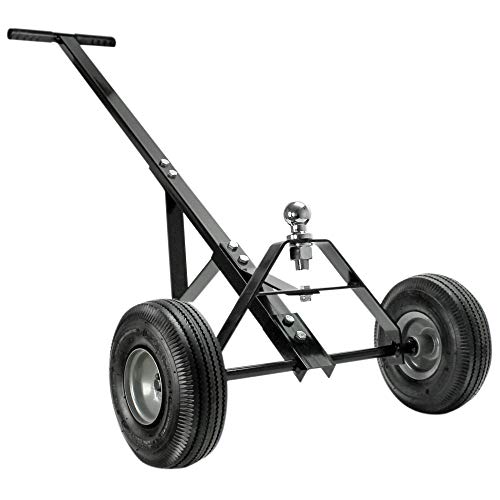
Best for Level Pavement – Extreme Max 5001.5766 Trailer Dolly
The Extreme Max 5001.5766 offers a straightforward option among manual trailer dollies for boat, snowmobile, and cargo trailers. Its all-steel frame supports up to 600 pounds, but the manufacturer specifies use on hard, dry, level surfaces.
Best For: Positioning a trailer on a level, dry driveway or other firm surface.
Pros:
- 600-pound load capacity and all-steel frame.
- 10-by-3.5-inch tires are designed to roll over rough spots.
- 47.25-inch handle and specified 16-inch ball height help with fit planning.
Cons:
- Not specified for wet, soft, or sloped ground.
- Fixed 16-inch ball height may not match every coupler setup.
Its stated surface restriction is the key buying consideration: this is better suited to a prepared parking area than an uneven yard.
Highest Tongue-Weight Rating – VEVOR 1200-Pound Trailer Dolly
For shoppers comparing higher-capacity manual trailer dollies, this VEVOR model has a stated 1,200-pound tongue-weight rating. It pairs a 2-inch hitch ball with 15.2-inch pneumatic tires and a third, swiveling wheel for maneuvering.
Best For: Moving a compatible trailer when a 600-pound-rated dolly is insufficient.
Pros:
- 1,200-pound stated tongue-weight capacity.
- Large pneumatic tires are intended for surfaces including grass, sand, and pavement.
- Three-wheel design includes a swiveling wheel for turning.
- Powder-coated carbon steel frame.
Cons:
- 2-inch ball requires a matching trailer coupler.
- At 46.1 pounds, it is heavier than the other models listed here.
- No manufacturer warranty is specified.
The higher rating and larger tires broaden its potential uses, but check coupler size and tongue weight before buying; the rating alone does not guarantee easy movement on a slope.
Best for No-Inflation Tires – DAC039 600-Pound Trailer Dolly
This DAC039 stands out among manual trailer dollies for its 12-inch solid tires, which do not need inflation. It is rated for 600 pounds and comes with a 1-7/8-inch hitch ball for compatible small utility and watercraft trailers.
Best For: Owners of smaller trailers with 1-7/8-inch couplers who prefer solid tires.
Pros:
- Solid tires eliminate air-pressure checks.
- Included 1-7/8-inch ball.
- Powder-coated steel construction and long handle.
Cons:
- Included ball will not fit couplers requiring a different size.
- 600-pound rating limits use with heavier tongue weights.
If its ball size and capacity match your trailer, this is a convenient option for parking and storage without pneumatic-tire upkeep.
Heavy-Duty Pick – Trailer Tug Manual Dolly
Among manual trailer dollies, the Trailer Tug is built for positioning larger trailers on pavement or concrete. Its stated limits are 15,000 pounds of trailer weight and 3,500 pounds of tongue weight; the reinforced steel frame and wide base are intended to keep heavy loads stable.
Best For: Moving RV, boat, camper, or enclosed trailers into tight paved parking spaces without a tow vehicle.
Pros:
- High stated tongue-weight capacity of 3,500 pounds.
- Wide, reinforced steel frame for stable positioning.
- Manual operation requires no battery or charging.
Cons:
- Weighs 52 pounds, making it less convenient to carry than a lighter dolly.
- Described for use on pavement or concrete; suitability for loose ground is not specified.
Choose this one when load ratings and precise positioning matter more than easy carrying. Check your trailer’s weight and tongue weight against the stated limits before buying.
Small-Trailer Pick – 600-lb Dolly with Solid Tires
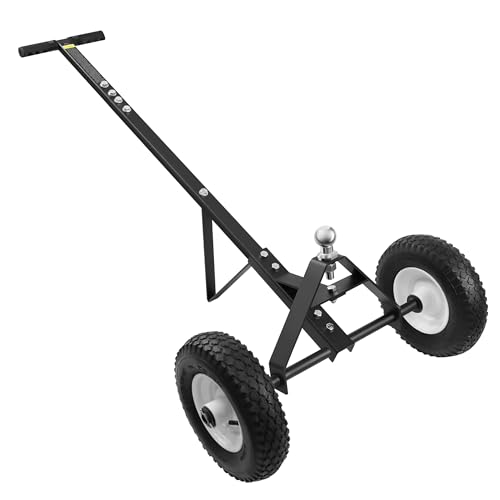
For shoppers comparing manual trailer dollies for smaller utility or watercraft trailers, this model pairs a stated 600-pound capacity with a 1-7/8-inch hitch ball. Its two 12-inch solid tires need no inflation, while the long handle provides leverage for driveway and storage-area positioning.
Best For: Moving compatible small trailers in a driveway, garage, or storage area.
Pros:
- Solid tires eliminate tire-inflation upkeep.
- Long handle offers leverage when pushing or pulling.
- Powder-coated steel construction helps resist rust and wear.
Cons:
- 600-pound stated capacity is lower than the other dollies in this roundup.
- Included 1-7/8-inch ball will not fit trailers requiring a different ball size.
This is the more straightforward choice for a small trailer with a matching coupler. Confirm what the 600-pound rating means for your loaded setup before use.
Dual-Hitch Pick – 20,000-lb Swivel-Wheel Dolly
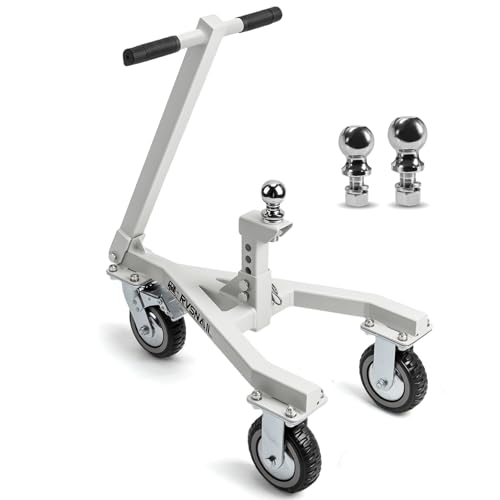
This option stands out among manual trailer dollies for its stated 20,000-pound trailer and 3,500-pound tongue-weight limits. It also includes 2-inch and 2-5/16-inch hitch balls, adjustable height, and 360-degree swivel wheels with a brake for positioning in tight spaces.
Best For: Owners of larger trailers who need both included hitch-ball sizes and swivel-wheel maneuverability.
Pros:
- High stated trailer and tongue-weight ratings.
- Two included ball sizes and adjustable height broaden fit options.
- Swivel wheels aid tight turns, and the brake helps hold position when parked.
Cons:
- No 1-7/8-inch hitch ball is listed.
- Product notes do not specify an item weight or recommended ground surfaces.
Its hitch options and caster setup make it worth considering for varied trailer couplers. Verify coupler fit, trailer weights, and the surface where you plan to move it before purchasing.
Most Versatile Setup – MaxxHaul 70881 Dual-Pull Trailer Dolly
Among manual trailer dollies, the MaxxHaul 70881 stands out for its convertible towing and manual positions. Its long handle provides leverage, while the two 12-inch knobby pneumatic tires are designed for all-terrain rolling.
Best For: Buyers who want a 1-7/8-inch hitch ball and the option to switch between manual and towing setups.
Pros:
- Converts between towing and manual positions.
- Long handle helps with maneuvering.
- Two 12-inch by 4-inch knobby pneumatic tires on steel rims.
Cons:
- 1-7/8-inch ball will not match a 2-inch coupler.
- Specified for off-road use only.
Its 600-pound capacity and convertible design make it a flexible choice, provided its ball size and off-road-use restriction fit your setup.
Highest Stated Capacity – VEVOR 1000-lb Three-Wheel Trailer Dolly
If tongue weight is your priority when comparing manual trailer dollies, this VEVOR model lists a 1,000-pound capacity. It pairs a 2-inch hitch ball with two 14-inch pneumatic tires and a third, swiveling wheel for turning.
Best For: Repositioning compatible boat, utility, or cargo trailers when you want a higher stated tongue-weight capacity.
Pros:
- 1,000-pound stated tongue-weight capacity.
- Third wheel helps with turning.
- 14-inch pneumatic tires and a 39.4-inch handle.
- Powder-coated carbon-steel construction.
Cons:
- 2-inch ball requires a matching coupler.
- At 40.1 pounds, it is heavier than the 29-pound MaxxHaul model in this roundup.
The three-wheel layout offers a different approach to maneuvering than a basic two-wheel dolly. Check your trailer’s tongue weight and coupler size before choosing it.
Best Simple Pick – 600-lb Two-Wheel Trailer Dolly
For straightforward parking adjustments, this two-wheel option keeps things simple among manual trailer dollies. It has a 2-inch hitch ball, dual 13-inch pneumatic tires, and a stated 600-pound tongue-weight capacity for use on hard, level surfaces.
Best For: Moving a compatible trailer forward or backward on level concrete or asphalt in a driveway, storage yard, or open garage.
Pros:
- Integrated 2-inch hitch ball needs no separate adapter for a matching coupler.
- Dual 13-inch pneumatic tires support straight-line moves on pavement.
- Powder-coated steel frame.
Cons:
- Designed for hard, level surfaces rather than rough terrain.
- Not intended for road towing.
Choose this one for simple positioning on suitable pavement, not for uneven-ground moves or towing a trailer on the road.
How We Picked These Manual Trailer Dollies
We compared the listed tongue-weight or load ratings, hitch-ball sizes, tire designs, and maneuvering features across the 10 selected models. We also considered practical differences such as pneumatic versus solid tires, dual-pull handles, swivel wheels, and brakes. These are specification-based comparisons, not claims of hands-on testing. Confirm each manufacturer’s current rating and instructions before buying, especially where a listing says “load capacity” without clearly defining tongue weight.
Quick Comparison: Which Type Fits Your Trailer?
For smaller boat, jet ski, and utility trailers, the 600-pound-rated options offer several tire and hitch-ball configurations. MaxxHaul’s 70225 and 70881 list 12-inch pneumatic and all-terrain knobby tires, respectively; another 600-pound option lists solid tires for buyers who would rather avoid flats. Check coupler fit carefully: the selected light-duty models include both 1-7/8-inch and 2-inch balls.
VEVOR’s 1,000- and 1,200-pound-rated models list 2-inch balls and larger pneumatic tires, making them options to consider when your measured tongue weight exceeds a 600-pound dolly’s rating. The Trailer Tug and heavy-duty swivel-wheel model list much higher capacities, but their suitability still depends on coupler fit, surface conditions, and the manufacturer’s operating limits. A high advertised trailer-weight figure is not a substitute for checking tongue weight.
Key Buying Factors for Manual Trailer Dollies
Loaded Tongue Weight and Hitch Fit
Use the tongue weight of the trailer as you actually move it, with its usual cargo and equipment aboard. Choose a dolly whose applicable rating exceeds that weight; do not assume a trailer’s total weight equals the weight carried by the dolly. Match the ball to your coupler exactly—1-7/8-inch, 2-inch, and 2-5/16-inch sizes are not interchangeable. If a listing’s capacity or ball specification is unclear, verify it with the seller or manufacturer.
Ground Conditions, Tires, and Control
Pneumatic tires can help on uneven pavement or firm gravel, but need inflation and can puncture. Solid tires avoid flats, though they may be less forgiving over bumps. Larger wheels and tread can make a difference on imperfect surfaces; none guarantees easy movement on soft soil, steep grades, or loose gravel. For tight spaces, consider handle clearance, turning room, and whether swivel wheels or a brake help with positioning. Keep the trailer under control at all times, and follow the dolly maker’s guidance on slopes.
Who Should Buy Which Manual Trailer Dollies?
Choose a 600-pound-rated dolly if your loaded tongue weight is comfortably within its verified rating and its ball matches your coupler. Consider a 1,000- or 1,200-pound-rated model when you need more tongue-weight capacity and a 2-inch ball. Look at the heavy-duty options for substantially heavier trailers, but verify their stated tongue-weight limits and intended surfaces before relying on them. If your trailer is difficult to move by hand even on level ground, a powered mover or professional help may be more appropriate than a larger manual dolly.