
Working in a cramped area calls for more than a small grinder. The best angle grinders for tight spaces combine a compact head, manageable profile, precise control, and enough power for the material at hand.
This roundup compares 10 cordless, pneumatic, flat-head, and right-angle options so you can choose a tool that fits your workspace without sacrificing safety or useful performance.
Best 10 Angle Grinders for Tight Spaces Picks for 2026
Best Cordless Reach

- Flat-head neck reaches behind pipes and into corners
- Brushless motor with up to 11,000 RPM
- Compatible with DeWalt 20V batteries
Best For: DeWalt 20V users working in cramped areas
Best Pneumatic Precision
Ingersoll Rand 301B Air Die Grinder

- Compact right-angle design for confined areas
- 21,000 RPM air-powered performance
- Lightweight 1.02-pound aluminum-bodied tool
Best For: Automotive and fabrication shops with an air compressor
Best Safety Features
Milwaukee M18 FUEL Flathead Grinder

- Low-profile head reaches difficult tight spaces
- RAPIDSTOP brake stops most wheels in under two seconds
- Cordless M18 platform with brushless performance
Best For: M18 users prioritizing access and rapid braking
Best Variable-Speed Value

- Three speeds from 4,500 to 11,000 RPM
- Low-profile head reaches weld seams and hidden gaps
- LCD shows speed setting and battery level
Best For: DEWALT 20V users needing adjustable grinding speeds
Best Compact Right-Angle Pick

- Compact right-angle design for confined access
- Brushless 12V cordless motor
- LED light and spindle lock
Best For: Detailed metal cleanup, prep, and cutting in tight spaces
Best Corded Value
DEWALT 4-1/2-Inch Angle Grinder

- 7-amp motor with 12,000-rpm speed
- Slim ergonomic body
- Tool-free guard and wheel release
Best For: Corded material removal using standard 4-1/2-inch accessories
Best Ultra-Compact Cutting Pick

- Compact design for difficult cuts
- 19,500-rpm no-load speed
- Brushless motor with protection features
Best For: Confined cutting of threaded rod, strut, conduit, and tile
Compact Pneumatic Pick
WORKPRO Right-Angle Die Grinder

- 90-degree head for confined work areas
- 20,000 RPM pneumatic operation
- 1/4-inch and 1/8-inch collets included
Best For: One-handed detail grinding, deburring, and polishing
Safety-Focused Cordless Pick

- Cordless 4-1/2-inch grinder format
- Brushless motor with no brush changes
- Kickback brake and rapid wheel brake
Best For: Portable grinding without an air hose or power cord
Precision Mini Pick
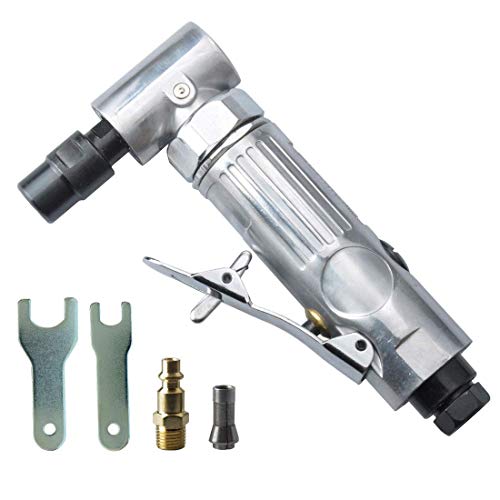
- 90-degree head reaches angled surfaces
- Variable-speed throttle and air regulator
- 1.1-pound aluminum body for control
Best For: Precision deburring, engraving, polishing, and finishing
Best Cordless Reach – Ecarke Flat Head Grinder
The Ecarke Flat Head Grinder is designed for angle grinders for tight spaces, with an extended flat-head neck that reaches behind pipes, into corners, and around edges. It uses compatible DeWalt 20V batteries, accepts common accessories with a 5/8-inch arbor, and includes vibration-reduction features for longer work sessions.
Best For: DeWalt 20V users who need cordless access in cramped grinding and cutting areas.
Pros:
- Extended flat-head design improves access behind pipes and in tight corners.
- Brushless 1000W motor delivers speeds up to 11,000 RPM.
- Tool-free guard adjustment simplifies changes between tasks.
- Floating motor and anti-vibration handles help reduce hand fatigue.
Cons:
- Battery and charger are not included.
- Overheat protection may place the tool in standby during prolonged heavy use.
- Compatibility is intended for DeWalt 20V batteries.
Choose this model when cordless convenience and maximum reach are priorities. Its cooling and overheat-protection systems are useful for demanding work, though extended heavy-duty jobs may require cooling pauses.
Best Pneumatic Precision – Ingersoll Rand 301B Air Die Grinder
The Ingersoll Rand 301B is a compact right-angle air die grinder for tight spaces, offering a 21,000 RPM maximum speed in a lightweight 1.02-pound body. Its pneumatic design provides continuous air-powered output for grinding, cutting, and polishing in automotive, fabrication, and industrial work.
Best For: Workshops with an air compressor that need a lightweight tool for continuous precision work.
Pros:
- Right-angle configuration improves maneuverability in confined areas.
- 21,000 RPM maximum speed supports grinding, cutting, and polishing.
- Self-locking throttle helps prevent unintentional activation.
- Includes 1/4-inch and 6 mm collets with two wrenches.
Cons:
- Requires an air compressor, which is not included.
- Uses a 1/4-inch collet rather than standard angle-grinder wheels.
- Air hoses can limit portability compared with cordless tools.
The 301B is a practical choice for compressor-equipped shops that value steady output and compact handling. Its right-angle form and low weight make it especially suitable for detailed work in hard-to-reach areas.
Best Safety Features – Milwaukee M18 FUEL Flathead Grinder
The Milwaukee M18 FUEL Flathead Grinder combines cordless operation with a low-profile design made for angle grinders for tight spaces. Its flathead housing improves access where a traditional 5-inch grinder may not fit, while the RAPIDSTOP brake stops most wheels in less than two seconds.
Best For: M18 users who want a compact flathead grinder with rapid wheel braking.
Pros:
- Low-profile flathead design provides improved access in confined spaces.
- RAPIDSTOP brake stops most wheels in less than two seconds.
- Brushless cordless platform generates performance comparable to an 11A corded tool.
- Paddle switch without lock supports controlled operation.
Cons:
- Battery and charger are not included.
- Maximum speed is 8,500 RPM, lower than some listed alternatives.
- Designed around Milwaukee’s M18 battery platform.
This grinder is a strong fit when access and braking performance matter more than maximum RPM. The low-profile head helps with confined cuts and grinding, while RAPIDSTOP adds a useful safety-oriented feature.
Best Variable-Speed Value – DEWALT 20V Flat Head Grinder
This flat-head grinder is built for angle grinders for tight spaces, with a low-profile gear housing that reaches behind frames, into gaps, and along weld seams. It accepts 4-1/2-inch and 5-inch wheels, offers three speed settings, and runs on DEWALT 20V MAX batteries.
Best For: DEWALT battery owners who want adjustable speeds for cutting, grinding, and polishing.
Pros:
- Flathead housing reaches hidden gaps and confined corners.
- Three speed settings provide 4,500, 7,500, and 11,000 RPM options.
- LCD screen displays the selected speed and remaining battery level.
- Tool-free guard and adjustable handles support flexible positioning.
Cons:
- Battery is not included.
- Product support information specifies a 30-day return period rather than a longer warranty.
- Its DEWALT 20V MAX compatibility limits battery-platform choice.
The adjustable speed range makes this a versatile option for users switching between aggressive cutting, heavier grinding, and fine polishing. It is particularly compelling for DEWALT 20V owners who need more control in confined metalworking tasks.
Best Compact Right-Angle Pick – M12 FUEL 1/4-Inch Die Grinder
For angle grinders for tight spaces, the Milwaukee M12 FUEL stands out as a compact right-angle die grinder with a 1.7-pound body and ergonomic barrel grip. Its 12V battery power, LED work light, and 1/4-inch format suit detailed metal cleanup, surface preparation, and cutting tasks where a larger grinder may be awkward.
Best For: Metal cleaning, surface prep, and cutting in confined work areas.
Pros:
- Right-angle design and ergonomic barrel grip are suited to tight spaces.
- POWERSTATE brushless motor delivers cordless performance.
- Shadowless LED work light improves visibility around the work area.
- Spindle lock supports one-wrench accessory changes.
Cons:
- Requires 12V batteries, which are not specified as included.
- Its 1/4-inch die-grinder format may be less suitable for broad grinding than a larger angle grinder.
Choose this Milwaukee when access and maneuverability matter more than covering large surfaces. The compact cordless design is particularly practical for controlled detail work in obstructed areas.
Best Corded Value – DEWALT 4-1/2-Inch Angle Grinder
The DEWALT DWE4011 is a corded option for angle grinders for tight spaces when you want a slim body and full-size 4-1/2-inch accessory compatibility. Its 7-amp, 12,000-rpm motor is built for material removal, while the removable two-position handle helps with control in cramped or changing work positions.
Best For: Corded grinding and material removal with widely available 4-1/2-inch accessories.
Pros:
- Slim, ergonomic body is designed for comfort during extended use.
- 7-amp AC/DC motor reaches up to 12,000 rpm.
- One-Touch guard adjusts without a tool.
- Quick-Change wheel release allows tool-free wheel removal.
Cons:
- Corded operation limits mobility around tight or remote work areas.
- At 3.9 pounds, it is heavier than the listed cordless alternatives.
- It uses a 4-1/2-inch grinder format rather than a highly compact die-grinder profile.
This DEWALT makes sense when continuous AC/DC power and standard 4-1/2-inch accessories are priorities. Its slim housing improves handling, but the cord and heavier build may be less convenient in especially restricted spaces.
Best Ultra-Compact Cutting Pick – Bosch 12V Max 3-Inch Grinder
The Bosch GWS12V-30N is designed specifically for difficult cuts in tight spaces, making it a strong choice among angle grinders for tight spaces. This 12V Max bare tool has a palm-fitting body, a 3-inch wheel, 19,500 no-load rpm, and a brushless motor intended to maximize battery runtime during extended applications.
Best For: Quick, confined cuts through threaded rod, strut, conduit, and tile.
Pros:
- Compact 3-inch design is made for access in restricted areas.
- High 19,500-rpm no-load speed supports quick cutting.
- Brushless motor helps maximize battery runtime.
- Restart and overload protection add practical safeguards.
Cons:
- Sold as a bare tool, so a compatible 12V battery is required.
- The 3-inch format provides less coverage for broad grinding than larger models.
- Battery, charger, and warranty coverage are not included in the supplied component list.
For restricted cuts where a conventional grinder cannot fit comfortably, the Bosch combines a small footprint with very high no-load speed. Its bare-tool status is the main purchasing consideration for users who do not already own Bosch 12V Max batteries.
Compact Pneumatic Pick – WORKPRO Right-Angle Die Grinder
For angle grinders for tight spaces, the WORKPRO Air Angle Die Grinder is a compact pneumatic option with a 90-degree head, 20,000 RPM free speed, and a one-pound body. Its two collets support a range of small grinding, polishing, deburring, and cutting tasks, provided you have a suitable air compressor.
Best For: One-handed automotive repair, detail grinding, deburring, and polishing in confined or angled areas.
Pros:
- 90-degree head improves access to tight and angled work areas.
- Includes both 1/4-inch and 1/8-inch collets.
- Lightweight 6-5/16-inch design supports one-handed use.
- Rear exhaust directs air away from the operator.
Cons:
- Requires an air compressor, which is not included.
- Air consumption is listed at 3 CFM at 90 psi, so compressor capacity matters.
- The dust plug must be removed before installing the air connector.
This is a strong fit when compact access and sustained pneumatic power matter more than cordless convenience. The included collets also make it more versatile for small-detail work.
Safety-Focused Cordless Pick – DEWALT 20V MAX Angle Grinder
Among angle grinders for tight spaces, the DEWALT DCG413B offers cordless maneuverability in a 4-1/2-inch format. Its brushless motor, paddle switch, kickback brake, and electronic brake are designed for controlled operation when access is limited. This is a tool-only purchase, so a compatible 20V MAX battery is required.
Best For: Cordless cutting and grinding where avoiding an air hose or power cord is useful.
Pros:
- Cordless 20V MAX platform improves portability around a work area.
- Brushless motor requires no brush changes.
- Brake stops the wheel in two seconds or less on average.
- Kickback Brake responds to sensed pinch, stall, or bind-up events.
Cons:
- Battery and charger are not included.
- At 3.8 pounds, it is substantially heavier than the pneumatic mini grinders here.
- Its 4-1/2-inch grinder format may be less suitable for extremely small spaces than a die grinder.
The DEWALT is the more practical choice when cordless freedom and integrated protection features outweigh the smaller footprint of a mini pneumatic grinder. Confirm that you already own compatible DEWALT 20V MAX batteries before buying.
Precision Mini Pick – PROSHI 1/4-Inch Angle Grinder
The PROSHI 1/4-inch Mini Angle Grinder is built for angle grinders for tight spaces, using a 90-degree head and lightweight aluminum body to reach confined or angled surfaces. Its variable-speed throttle and built-in air regulator provide more control for precision machining, engraving, deburring, polishing, and similar detail work.
Best For: Precision finishing, chamfering, engraving, and deburring where a small pneumatic tool is easier to maneuver.
Pros:
- 90-degree design helps reach tight and angled grinding areas.
- Variable-speed throttle and built-in regulator support speed control.
- Lightweight 1.1-pound aluminum body is easy to handle.
- Includes a backup 1/8-inch collet, two wrenches, and a quick connector.
Cons:
- Requires an air supply for operation.
- The 1/4-inch collet format is intended for smaller accessories rather than large grinding wheels.
- Its 20,000 RPM speed requires appropriate accessory selection and controlled handling.
Choose the PROSHI when precision and maneuverability are the priorities. The regulator and variable-speed throttle give it an advantage for delicate work, while the rear exhaust and sealed bearings support workshop use.
How We Picked the Best Angle Grinders for Tight Spaces
We focused on the features that matter most when access is limited: overall tool size, head shape, grip and switch placement, power source, speed, accessory compatibility, and safety controls. The selection includes compact 12V and 18V cordless tools, flat-head grinders designed for improved clearance, and pneumatic die grinders for detailed work in confined areas.
We also considered practical ownership factors, including whether batteries and chargers are included, the available collet or wheel sizes, braking and kickback protection, guard adjustment, and suitability for cutting, grinding, deburring, or polishing. A compact design is useful only when it remains controllable and appropriate for the job.
Quick Comparison
| Type | Best suited for | Main advantage |
|---|---|---|
| Flat-head cordless grinder | Grinding near obstructions | Improved head clearance |
| Compact cordless angle grinder | Portable cutting and surface work | No air hose or compressor |
| Right-angle die grinder | Detail work and narrow access | Small abrasive accessories |
| Pneumatic die grinder | Continuous shop use | Lightweight, consistent operation |
| Standard 4-1/2-inch grinder | General fabrication and repair | Broad accessory availability |
Key Buying Factors for Angle Grinders for Tight Spaces
Head Profile and Access
A flat-head or right-angle design can reach beneath brackets, between welds, and close to adjacent surfaces more effectively than a conventional grinder. Check the tool’s actual head thickness and accessory clearance rather than relying on the product label alone.
Power Source and Runtime
Cordless models are easier to position around vehicles, construction sites, and outdoor projects, but confirm battery compatibility and remember that many listings are tool-only. Pneumatic models can be lighter and well suited to shop use, although they require a compressor, hose, and adequate airflow.
Accessory Size and Control
Small die grinders use collets for burrs, stones, and small abrasive tools, while angle grinders generally accept discs. Match the tool to the task: a die grinder offers precision in narrow areas, whereas a 4-1/2- or 5-inch grinder removes material faster. Variable-speed control, a paddle switch, and a comfortable grip can improve handling during delicate work.
Safety Features
Look for a properly adjustable guard, spindle or disc compatibility, electronic braking, overload protection, and kickback reduction where available. Always use the correct wheel or accessory, eye and hearing protection, gloves suited to the task, and respiratory protection when creating dust.
Who Should Buy Which Angle Grinders for Tight Spaces?
- Choose a flat-head cordless model if clearance around the workpiece is your top concern and you already own a compatible battery platform.
- Choose a compact 12V or right-angle die grinder for light deburring, porting, polishing, and precision work in very narrow spaces.
- Choose a pneumatic die grinder for frequent shop use when you have a compressor capable of supplying the required airflow.
- Choose a standard 4-1/2-inch cordless grinder if you need a versatile tool for cutting, grinding, and flap-disc work beyond confined areas.
Before buying, measure the access point, identify the accessory size you need, and verify battery, compressor, and guard requirements. The best option is the smallest tool that safely handles your material and workload.