
A five-channel amplifier can power four cabin speakers and a subwoofer from one chassis, simplifying an upgrade without giving up control over bass. The right choice depends less on the biggest advertised wattage and more on usable power, speaker compatibility, and fit.
These 10 options span compact Class D designs, higher-output models, and amps with connections suited to different source units. Use the buying guide below to narrow the field around your actual system.
Best 10 5 Channel Car Amplifiers Picks for 2026
Best for 1-Ohm Subwoofers

- 1-ohm-stable mono channel
- 1,280W RMS mono at 1 ohm
- Remote bass knob included
Best For: Systems with a 1-ohm subwoofer load
Best for Marine-Ready Installs

- Conformal-coated circuit board
- Up to 600W RMS sub output at 2 ohms
- Variable crossover and bass controls
Best For: Marine-use installations needing flexible tuning
Best for Full-Range Flexibility
- Runs speakers and subwoofers
- Variable bass boost
- Remote subwoofer control included
Best For: Five-channel setups with ample mounting space
Best for Clear RMS Specs

- 1,000W RMS sub channel at 1 ohm
- Separate 2- and 4-ohm RMS ratings
- Remote bass knob included
Best For: Planning a system around load-specific RMS ratings
Best for AudioControl Integration

- Class D, five-channel design
- Remote sub level and bass EQ
- EPICENTER Link port
Best For: Aftermarket-head-unit builds using AudioControl bass gear
Best for Monitoring

- 800W RMS total stated output
- Built-in voltmeter and clip indicator
- Bass knob and cable included
Best For: Four-speaker-and-sub systems needing visible setup feedback
Best for a 1-Ohm Subwoofer

- 770W RMS sub rating at 1 ohm
- Four 125W RMS channels at 2 ohms
- Compact 8.11 x 6.1 x 1.81-inch chassis
Best For: Compact four-speaker builds with a 1-ohm subwoofer load
Best for Hi-Res Audio

- Hi-Res certified; response up to 50,000 Hz
- Compact Class D five-channel design
- 40–240 Hz low-pass filter and remote bass knob
Best For: Compact full-system builds with Hi-Res support
Best for Flexible Inputs

- High-level and RCA inputs
- Adjustable crossovers and bass boost
- 19.7-inch-long Class A/B chassis
Best For: Systems needing speaker-wire or RCA input flexibility
Best for Detailed Tuning

- Hi-Res certified Class D design
- High-pass, low-pass, and subsonic filters
- Published RMS configurations and wired sub remote
Best For: Tunable speaker-and-subwoofer systems
Best for 1-Ohm Subwoofers – Recoil RED1800.5
Among 5 channel car amplifiers, the Recoil RED1800.5 is a practical choice when your subwoofer setup calls for a 1-ohm-stable mono channel. It pairs four speaker channels with a dedicated sub channel in a Class-D design.
Best For: Systems needing a 1-ohm subwoofer channel and a bass knob within reach.
Pros:
- Mono channel is rated at 1,280W RMS at 1 ohm.
- Includes a remote bass control knob.
- Provides adjustable gain, low-pass and subsonic filters, plus bass EQ.
Cons:
- Its 1,800W maximum rating is not a continuous-power figure; compare the RMS ratings for your speaker impedance.
- At 14.6 by 7.6 inches, it needs a suitable mounting space.
The standout feature is subwoofer wiring flexibility, but check the separate RMS ratings for the four speaker channels and mono channel before choosing speakers.
Best for Marine-Ready Installs – NVX VAD11005 v2
If you are comparing 5 channel car amplifiers for a vehicle that may see marine use, the NVX VAD11005 v2 stands out for its conformal-coated circuit board. Its five-channel Class-D layout also offers configurable filtering for speakers and a subwoofer.
Best For: Car, truck or marine installations that need a coated circuit board and adjustable sound controls.
Pros:
- Rated at 125W RMS times four plus 600W RMS for the sub channel at 2 ohms.
- Conformal-coated circuit board is designed for marine environments.
- Variable high-pass, low-pass and subsonic filters, with adjustable bass boost.
- Supports 5-, 4- or 2-channel operation.
Cons:
- The specified ratings describe 2- and 4-ohm operation, not a 1-ohm subwoofer load.
- Its 2,200W peak figure should not be confused with its 1,100W RMS rating.
This is the more adaptable pick when installation environment and tuning options matter; match your planned speaker loads to its stated impedance ratings.
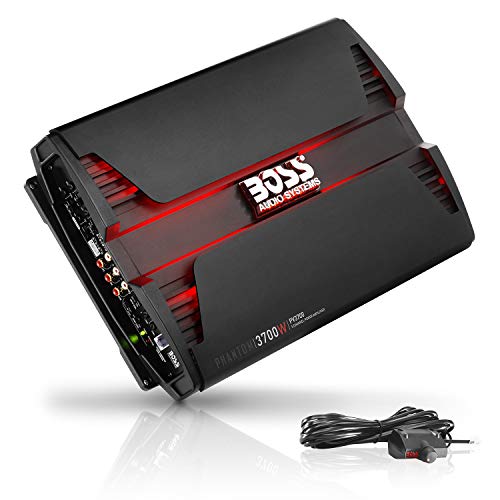
Best for Full-Range Flexibility – BOSS Audio PV3700
The BOSS Audio PV3700 is worth a look among 5 channel car amplifiers if you want to run speakers and subwoofers from one full-range unit. It includes variable bass boost and a remote subwoofer control.
Best For: Buyers planning a five-channel speaker-and-subwoofer setup with room for a larger amplifier.
Pros:
- Full-range design supports speakers and subwoofers.
- Variable bass boost and included remote subwoofer control.
- Specified for 2- to 8-ohm speaker impedance.
Cons:
- Its 17-by-10.31-inch footprint requires more mounting room than a compact amplifier.
- The supplied specifications give a 3,700W maximum figure but no channel-by-channel RMS ratings for load matching.
Choose this model for its full-range layout and bass controls, while verifying the power your particular speakers need before relying on the maximum-power figure.
Best for Clear RMS Specs – CT Sounds CT-1500.5D
For shoppers comparing 5 channel car amplifiers by continuous output, the CT Sounds CT-1500.5D lists separate RMS ratings for its four speaker channels and subwoofer channel at multiple impedances. This Class-D model also includes a remote bass knob.
Best For: Buyers who want stated RMS ratings for 1-, 2- and 4-ohm subwoofer loads.
Pros:
- Subwoofer channel is rated at 1,000W RMS at 1 ohm.
- Four speaker channels are rated at 210W RMS each at 2 ohms or 120W RMS each at 4 ohms.
- Includes a remote bass knob and four-way protection against voltage, current and temperature faults.
Cons:
- The supplied notes do not specify its dimensions, so confirm available mounting space before buying.
- The 1-ohm RMS rating applies to the subwoofer channel, not the four speaker channels.
Its detailed load-specific ratings make system planning easier; select the figures that match each channel’s intended impedance.
Best for AudioControl Integration – AudioControl EPICFIVE
Among 5 channel car amplifiers, the AudioControl EPICFIVE is a practical choice if you want one Class D amp for your speakers and subwoofer, plus a direct connection to an AudioControl EPICENTER processor. Its low-profile chassis measures 6.1 x 13.35 x 2.01 inches.
Best For: Aftermarket-head-unit systems that need adjustable bass and optional EPICENTER integration.
Pros:
- Includes an ACR-E dash-mountable subwoofer level control and cable.
- Offers a 0–12 dB bass EQ and 12 dB/octave Linkwitz-Riley crossovers.
- Built-in protection covers voltage, short-circuit, and thermal issues.
Cons:
- The recommended 150A fuse is sold separately.
- The EPICENTER processor is sold separately.
The included remote and tuning controls make this a flexible single-amp setup. Choose it for its integration features, and confirm your installation has room for the chassis and recommended fuse.
Best for Monitoring – Rockville Krypton F5
The Rockville Krypton F5 stands out among 5 channel car amplifiers for its built-in voltmeter and clip indicator. Its stated 800W RMS total output includes 75W RMS to each of four speaker channels at 4 ohms and 400W RMS to the subwoofer channel at 2 ohms.
Best For: Buyers who want visible voltage and clipping feedback while powering four speakers and a subwoofer.
Pros:
- Built-in voltmeter and clip indicator help with system monitoring and setup.
- Includes a bass knob and cable for adjusting subwoofer level from the driver’s seat.
- Provides separate stated RMS ratings for the speaker and subwoofer channels.
Cons:
- Its 15.35 x 8.66 x 2.2-inch chassis requires a fit check before purchase.
- Factory-stereo installations may need a separately sold line output converter and RCA cables.
This is a useful pick when you value monitoring features alongside an included bass knob. Plan around the mounting dimensions and any adapters your source unit requires.
Best for a 1-Ohm Subwoofer – RECOIL DI1300.5
If a 1-ohm subwoofer load is part of your plan, the RECOIL DI1300.5 is one of the 5 channel car amplifiers here with a stated 770W RMS subwoofer rating at 1 ohm. It also lists 125W RMS for each of four speaker channels at 2 ohms, in a chassis measuring 8.11 x 6.1 x 1.81 inches.
Best For: Compact installations pairing four speakers with a 1-ohm subwoofer load.
Pros:
- Subwoofer channel is rated for 1-ohm operation.
- Offers HPF/Full/LPF crossover options, variable bass controls, and a clip indicator.
- Protection circuitry addresses overheating, short circuits, and overloads.
Cons:
- The supplied notes do not specify an included remote bass knob.
- The stated 125W speaker-channel rating is at 2 ohms; verify output requirements for your speaker load.
Its compact dimensions and 1-ohm sub channel make it appealing for a space-conscious, bass-focused build. Match your speakers and subwoofer to the stated load-specific ratings rather than the 2600W maximum figure.
Best for Hi-Res Audio – Pioneer GM-DX975
Among 5 channel car amplifiers, the Pioneer GM-DX975 is a compact Class D option for powering a full speaker-and-subwoofer system while supporting Hi-Res Audio playback.
Best For: Drivers who want Hi-Res support and subwoofer control in a compact five-channel amp.
Pros:
- Frequency response extends to 50,000 Hz, with Hi-Res certification.
- Variable low-pass filter adjusts from 40 to 240 Hz; a remote bass knob is included.
- Compact Class D design and gold-plated RCA connections.
Cons:
- The stated 2,000-watt figure is maximum output, not an RMS rating.
- Listed warranty is one year.
Its protection system monitors voltage, current consumption, and temperature, making this a well-equipped choice when installation space and sound adjustment both matter.
Best for Flexible Inputs – Planet Audio AC1800.5
The Planet Audio AC1800.5 stands out among 5 channel car amplifiers for its high- and low-level inputs, giving buyers two ways to feed it a signal from a receiver while running speakers and a subwoofer.
Best For: Builds that need both speaker-wire and RCA input options in one full-range amp.
Pros:
- Accepts high-level speaker-wire and low-level RCA inputs.
- Offers high- and low-pass crossovers, variable bass boost, and bridgeable channels.
- Includes a subwoofer remote and a six-year Platinum Online Dealer Warranty for qualifying Amazon.com purchases.
Cons:
- At 19.7 x 10 x 2.4 inches and 14 pounds, it needs more mounting space than a compact amp.
- Advertised channel-power figures are maximum ratings, not stated RMS ratings.
This Class A/B model offers useful connection and tuning flexibility, but check your available mounting space and the warranty’s purchase condition before ordering.
Best for Detailed Tuning – Kenwood KAC-835
For shoppers comparing 5 channel car amplifiers, the Kenwood KAC-835 pairs a Class D design with Hi-Res Audio certification and a range of filters for tailoring speaker and subwoofer output.
Best For: Drivers who want multiple tuning controls and convenient subwoofer-level adjustment.
Pros:
- Hi-Res Audio certified, with adjustable high-pass, low-pass, and subsonic filters.
- Supplied RMS configurations include 50 W x 4 plus 300 W at 4 ohms, or 75 W x 4 plus 500 W at 2 ohms.
- Includes a wired remote for adjusting subwoofer level from the driver’s seat.
Cons:
- The advertised 1,600-watt output is a maximum rating rather than an RMS rating.
- The wired remote requires a cable connection.
Its published RMS configurations make system planning easier than relying on the maximum-power figure alone, while the filters give installers several ways to refine the sound.
How We Picked the Best 5 Channel Car Amplifiers
We focused on amps that can drive four main speaker channels plus a dedicated subwoofer channel. To make the selection useful across different builds, we considered stated RMS output, supported speaker loads, input options, crossover controls, installation footprint, and the clarity of each model’s published specifications. Peak or max wattage can describe short bursts under particular conditions; it is not a substitute for continuous RMS ratings. Verify current specifications before purchasing, especially when a listing omits the load or voltage used for its power claim.
Quick Comparison: Start with Your System
If you are replacing a factory radio, first look for an amplifier with compatible speaker-level inputs or plan for a suitable line-output converter. With an aftermarket receiver, check that its preamp outputs work with the amp’s input arrangement. Next, compare each model’s RMS power at the impedance you intend to use. A higher-output sub channel matters most if you have a subwoofer that can use it; otherwise, installation space, controls, and input flexibility may be more valuable than extra claimed watts.
Key Buying Factors for 5-Channel Car Amplifiers
RMS Power and Speaker Loads
Match the four full-range channels to your speakers’ continuous power ratings, then evaluate the fifth channel separately against your subwoofer’s RMS rating and final wired impedance. Check whether the sub channel is rated at 4 ohms, 2 ohms, or another supported load. Never assume that an advertised 2-ohm rating applies to every channel, or that an amp can safely drive any subwoofer wiring configuration.
Inputs, Crossovers, and Controls
Confirm how the amplifier accepts signal from your source unit. High-level inputs can simplify some factory-radio installations, while RCA inputs are common with aftermarket head units. Adjustable high-pass filters help keep deep bass out of door speakers; a low-pass filter directs appropriate frequencies to the sub. A subsonic filter can be useful with certain ported enclosures. Look for controls you can reach after installation, particularly if you expect to fine-tune the system.
Fit, Wiring, and Electrical Demands
Measure the mounting area and allow room for cables and ventilation. Check the manufacturer’s recommendations for power wire, grounding, and fuse protection rather than sizing wiring from a peak-watt figure. Higher-power systems can place greater demands on the vehicle’s electrical system. An amplifier that fits physically but cannot be wired and cooled properly is not a good fit.
Who Should Buy Which 5 Channel Car Amplifiers?
For a straightforward daily-driver upgrade, prioritize an amp whose verified RMS ratings suit your existing speakers and sub, with inputs that match your radio. If you are building around a more demanding subwoofer, narrow your choices by fifth-channel RMS output at its final impedance before comparing other features. Factory-system upgrades call for particular attention to signal compatibility; space-limited installs favor dimensions and airflow requirements you can accommodate. Whichever model you choose, plan your speaker wiring and installation before ordering so the advertised power is power your system can actually use.