
Finding the best automotive oscilloscope depends on more than channel count or bandwidth. The right tool should match your diagnostic workload, vehicle systems, portability needs, and comfort with waveform analysis.
This roundup compares handheld, USB, and scan-tool-integrated options, including versatile models with multimeters, signal generators, probes, and automotive-specific accessories.
Best 10 Automotive Oscilloscope Picks for 2026
Best Handheld Automotive Oscilloscope

- Four channels with 100 MHz bandwidth
- Automotive tests for sensors, networks, ignition, and more
- 8-inch Android touchscreen with 32GB storage
Best For: Technicians needing a portable, full-featured automotive diagnostic scope
Best Compact USB Scope

- Two-channel, 10 MHz USB oscilloscope
- Includes spectrum, waveform generation, and protocol tools
- Works with Windows, Linux, and Mac
Best For: Laptop-based general-purpose waveform analysis and compact workbenches
Best Circuit-Probe Oscilloscope
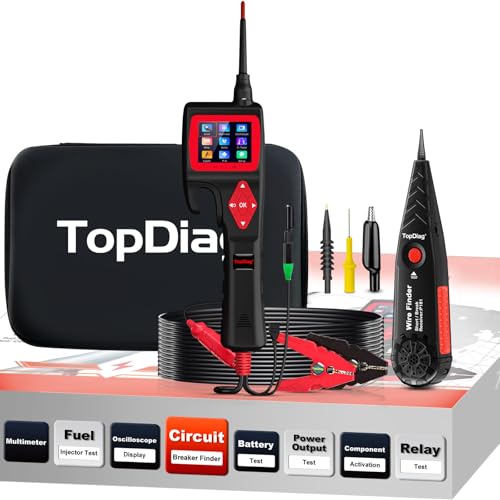
- Combines oscilloscope and multimeter functions
- Activates components and tests relays and batteries
- 20-foot cable for convenient vehicle access
Best For: Automotive electrical troubleshooting and multifunction circuit testing
Best Advanced Diagnostic Scope

- Four channels with 50M memory depth
- Recording, playback, math, FFT, and 23 measurements
- Requires a compatible TOPDON Phoenix diagnostic tool
Best For: Phoenix-equipped professional shops performing advanced waveform analysis
Versatile Diagnostic Pick

- Eight channels for multi-signal testing
- 80+ automotive diagnostic functions
- Built-in programmable signal generator
Best For: Windows-based automotive diagnostics and learning
Professional Automotive Pick
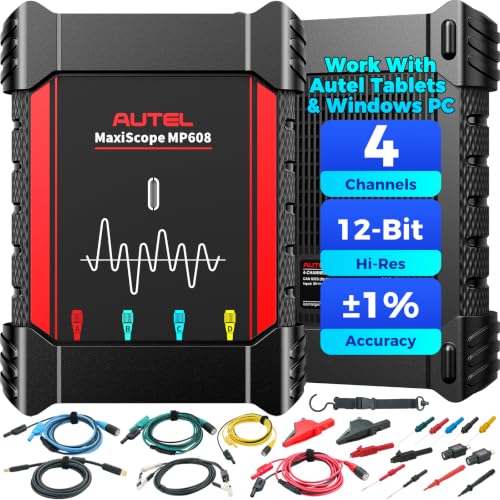
- Four-channel capture at up to 80 MS/s
- 20 MHz bandwidth with 32M memory depth
- Guided diagnostics and nine-protocol decoding
Best For: Advanced automotive waveform and network diagnostics
Best Multi-Channel Value
Hantek 1008C Automotive Scope Kit
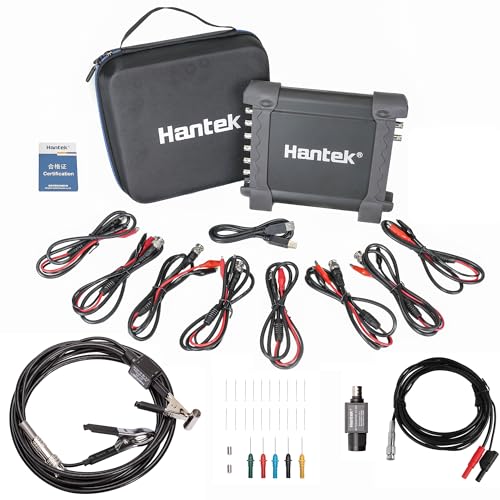
- Eight analog channels for simultaneous tests
- More than 80 built-in automotive diagnostic functions
- Programmable signal generator with included leads
Best For: PC-based automotive diagnostics and multi-channel testing
Best Professional Diagnostics
Autel MaxiScope MP608 Automotive Oscilloscope

- 12-bit capture with up to 80 MS/s single-channel sampling
- Advanced triggers for intermittent faults
- Decodes CAN FD, FlexRay, LIN, UART, and I²C
Best For: Professional shops and advanced vehicle network diagnosis
Best Simple Pick
ZT-703S Handheld Scope and Multimeter

- Oscilloscope, multimeter, and signal generator in one
- Up to 50 MHz bandwidth and 280 MSa/s sampling
- Battery-powered handheld design with Type-C charging
Best For: Portable electrical checks and general-purpose waveform testing
Best Handheld Automotive Oscilloscope – Micsig SATO1004
The Micsig SATO1004 is a capable automotive oscilloscope for technicians who want a portable, tablet-style instrument with four channels, broad connectivity, and dedicated vehicle diagnostic applications. Its 100 MHz bandwidth and 1 GSa/s sampling rate provide useful headroom for examining automotive signals.
Best For: Automotive technicians who need a standalone handheld scope for sensor, ignition, actuator, network, charging, starter, and pressure-related testing.
Pros:
- Four channels, 100 MHz bandwidth, and 1 GSa/s sampling rate
- Supports automotive tests including CAN, LIN, FlexRay, K, ignition, sensors, and actuators
- 8-inch touchscreen tablet design with Android and physical controls
- 32GB storage plus Wi-Fi, USB, LAN, HDMI, and Type-C connectivity
Cons:
- Its automotive-focused feature set may be more than needed for basic electrical checks
- Remote waveform viewing depends on a stable Wi-Fi connection
Choose the SATO1004 when portability and broad automotive coverage matter more than a minimal setup. The four-channel design and dedicated test support make it a strong fit for shop-level diagnostic work.
Best Compact USB Scope – PicoScope 2204A
The PicoScope 2204A is a compact USB oscilloscope for users who prefer running analysis software on a computer. It combines two channels with a 10 MHz bandwidth, spectrum analysis, waveform generation, serial-protocol decoding, and flexible measurement tools in a travel-friendly package.
Best For: Laptop-based electrical troubleshooting, education, small-scale setups, and general waveform analysis rather than dedicated automotive diagnostics.
Pros:
- Ultra-compact, USB-connected, and USB-powered design
- Includes two passive probes and supports up to 12-bit enhanced vertical resolution
- Offers oscilloscope, spectrum analyzer, function generator, and arbitrary waveform generator modes
- PS7 software supports Windows, Linux, and Mac with free updates and lifetime technical support
Cons:
- Only two channels and a 10 MHz bandwidth
- Requires a computer for operation
- Not compatible with PicoScope 7 Automotive Software
This is a practical choice if you want a small computer-based instrument and do not require a dedicated automotive software package. Buyers specifically seeking an automotive oscilloscope should consider Pico’s automotive models instead.
Best Circuit-Probe Oscilloscope – TOPDIAG P200 Circuit Probe
The TOPDIAG P200 is an automotive circuit probe that adds oscilloscope capability to a broad electrical diagnostic toolkit. Alongside waveform testing, it provides multimeter functions, component activation, relay testing, battery checks, polarity detection, and a 20-foot cable for reaching circuits without opening wiring.
Best For: DIY users and mechanics who want one handheld tool for automotive electrical troubleshooting, circuit testing, relay checks, and basic oscilloscope work.
Pros:
- Combines oscilloscope, multimeter, continuity, relay, battery, and circuit-testing functions
- Can apply power or ground at the probe tip to activate components
- Automatic-ranging measurements and prompts appear on the HD LCD screen
- Includes a 20-foot cable, LED light, injector-cleaning signals, and trailer-light testing
Cons:
- Oscilloscope functionality is part of a multifunction circuit probe rather than a dedicated bench scope
- Its automotive electrical focus may be less suitable for general electronics work
The P200 makes sense for users who value versatility and direct circuit access. It is especially useful when relay, battery, injector, polarity, and component-activation tasks are as important as viewing waveforms.
Best Advanced Diagnostic Scope – TOPDON Phoenix Scope
The TOPDON Phoenix Scope is a four-channel automotive oscilloscope designed for deeper waveform capture and analysis when paired with a compatible Phoenix diagnostic tool. Its 50M memory depth, recording and playback, advanced math, FFT analysis, and automatic measurements support detailed electrical troubleshooting.
Best For: Professional technicians who already use a compatible TOPDON Phoenix Max, Smart, Elite, Lite 3, Lite 2, Plus, or Plus 2 diagnostic tool.
Pros:
- Four-channel design with up to 50M memory depth
- Records, saves, replays, and compares waveform data
- Supports math operations, FFT analysis, advanced triggering, and 23 automatic measurements
- One-tap waveform storage and global-to-detail zoom support faster analysis
Cons:
- Does not work independently of compatible Phoenix diagnostic tools
- Not compatible with Phoenix Nano or XLink
- Its advanced features may be unnecessary for basic waveform checks
The Phoenix Scope is a strong expansion for an existing Phoenix diagnostic ecosystem. Confirm tool compatibility before buying, since its functionality depends on the required Phoenix platform.
Versatile Diagnostic Pick – Hantek 1008C
The Hantek 1008C is a practical automotive oscilloscope for users who want broad vehicle-diagnostic coverage alongside general electronics testing. Its eight channels, built-in automotive functions, and programmable signal generator make it useful for examining multiple signals and simulating crankshaft or camshaft inputs. Note that operation requires a Windows PC.
Best For: Automotive technicians, electricians, and hobbyists who want an eight-channel PC-based scope with guided diagnostic functions.
Pros:
- Eight analog channels for viewing multiple signals.
- Includes more than 80 automotive diagnostic functions.
- Programmable signal generator supports 0–250 kHz output and crankshaft/camshaft simulation.
- Offers 12-bit resolution, 4K memory depth, and 20 automatic measurement modes.
Cons:
- Requires a Windows computer and USB connection.
- Its 2.4 MSa/s real-time sampling rate is more modest than the sampling rates of the other options here.
The Hantek 1008C stands out for channel count and automotive-specific software features at a PC-based price point. It is a strong choice for learning and routine signal checks, provided a Windows setup fits your workspace.
Portable All-in-One Pick – FNIRSI 2C23T
The FNIRSI 2C23T combines a two-channel automotive oscilloscope with a multimeter and DDS signal generator in a compact handheld design. With 50 MSa/s sampling, automatic measurements, waveform storage, and a rechargeable battery, it suits mobile troubleshooting and general DIY electronics work.
Best For: DIY users, students, and technicians who want one battery-powered tool for basic waveform, electrical, and signal-generator tasks.
Pros:
- Handheld two-channel oscilloscope with 10 MHz bandwidth and 50 MSa/s sampling.
- Includes a 10,000-count multimeter with voltage, current, resistance, capacitance, diode, and continuity functions.
- Signal generator outputs seven waveform types up to 2 MHz.
- Built-in 3000mAh battery provides up to six hours of standby time.
Cons:
- Two channels provide less simultaneous coverage than four- or eight-channel scopes.
- Its oscilloscope bandwidth and memory depth are aimed more at general-purpose work than demanding high-speed diagnostics.
The 2C23T is the most convenient option when portability and tool consolidation matter. Its integrated meter and generator add practical value, while its two-channel layout keeps it better suited to straightforward automotive and electronics checks than complex multi-signal analysis.
Professional Automotive Pick – Autel MaxiScope MP608
The Autel MaxiScope MP608 is a professional automotive oscilloscope built for detailed waveform diagnostics. It captures four channels simultaneously at up to 80 MS/s, provides 20 MHz bandwidth and 32M memory depth, and adds guided presets, bus decoding, advanced triggers, math channels, and waveform comparisons.
Best For: Professional automotive technicians and Autel tablet owners diagnosing complex sensors, actuators, ignition systems, and vehicle communication networks.
Pros:
- Four-channel simultaneous capture with 20 MHz bandwidth, 80 MS/s sampling, and 32M memory depth.
- 12-bit resolution and ±1% accuracy support detailed low-level signal analysis.
- Includes guided diagnostics, auto scale, waveform library overlays, advanced triggers, filtering, and math functions.
- Decodes nine listed protocols, including CAN, CAN FD, LIN, FlexRay, RS232/UART, I2S, I2C, and USB.
Cons:
- Its advanced feature set may be more than beginners need for basic waveform checks.
- Standalone use requires a Windows 10/11 64-bit computer; tablet compatibility should be checked before purchase.
The MP608 is the strongest fit for demanding automotive waveform work, especially when paired with a compatible Autel scanner. Its higher specifications and diagnostic tools make it better suited to intermittent faults, network analysis, and complex circuit testing than entry-level scopes.
Best Multi-Channel Value – Hantek 1008C Automotive Scope Kit
The Hantek 1008C is a versatile automotive oscilloscope for users who want extensive channel coverage and built-in diagnostic functions without moving to a larger bench setup. It combines eight analog channels, more than 80 automotive test functions, and a programmable signal generator for tasks such as simulating crankshaft and camshaft signals.
Best For: Electricians, technicians, hobbyists, and learners who need multi-channel automotive diagnostics through Windows PC software.
Pros:
- Eight analog channels support multiple simultaneous measurements.
- Includes more than 80 automotive diagnostic functions covering ignition, sensors, buses, actuators, and starting or charging systems.
- Offers 12-bit resolution, 4K memory depth, automatic measurements, and a programmable 0–250 kHz signal generator.
Cons:
- Requires a Windows PC and USB connection rather than operating as a standalone handheld instrument.
- The supplied oscilloscope specification lists a 2.4 MSa/s real-time sampling rate, which is more modest than some specialized scopes.
This kit is a practical choice when channel count and automotive test coverage matter most. Its PC-based design and included leads make it especially useful for learning and structured troubleshooting.
Best Professional Diagnostics – Autel MaxiScope MP608 Automotive Oscilloscope
The Autel MaxiScope MP608 is a professional automotive oscilloscope designed for detailed waveform analysis and difficult intermittent faults. Its 12-bit capture, 20 MHz bandwidth, advanced triggering, custom math channels, and multi-protocol bus decoding make it suited to complex repair work.
Best For: Professional repair shops, mobile mechanics, and EV specialists working with subtle electrical faults and vehicle communication networks.
Pros:
- Captures high-detail waveforms with 12-bit resolution, ±1% DC accuracy, up to 80 MS/s single-channel sampling, and a 32M shared buffer.
- Advanced edge, pulse-width, window, and distortion triggers help catch fleeting faults.
- Decodes CAN, CAN FD, FlexRay, LIN, UART, and I²C, with guided automotive tests and automatic probe configuration.
Cons:
- Its broad professional feature set may be more than casual users need.
- Full compatibility is centered on listed MaxiSys tablets and Windows PCs.
The MP608 stands out when waveform precision, intermittent-fault capture, and network diagnostics are higher priorities than simplicity. It is the most technically capable option in this lineup for advanced automotive troubleshooting.
Best Simple Pick – ZT-703S Handheld Scope and Multimeter
The ZT-703S combines an automotive oscilloscope with a digital multimeter and signal generator in a battery-powered handheld design. It offers automatic waveform recognition, up to 50 MHz bandwidth in high-speed mode, and common multimeter functions for convenient electrical testing away from a workbench.
Best For: Portable troubleshooting and users who want one compact instrument for waveform checks, general electrical measurements, and basic signal generation.
Pros:
- Three functions in one device: oscilloscope, 25,000-count multimeter, and signal generator.
- High-speed mode reaches 280 MSa/s sampling and 50 MHz bandwidth.
- Battery power, Type-C charging, waveform storage, and included probe, test leads, cable, and bag support mobile use.
Cons:
- It has only two oscilloscope channels.
- High-speed mode uses more power, while normal mode is limited to 30 MHz bandwidth and 200 MSa/s.
- The manufacturer advises reading the manual because of the device’s multiple operating modes.
This is a convenient automotive oscilloscope for field work and general electronics testing. Choose it when portability and integrated multimeter functions are more important than extensive automotive-specific test libraries or channel count.
How We Picked the Best Automotive Oscilloscopes
We focused on tools suited to real automotive troubleshooting rather than general-purpose bench testing alone. Our comparison considers channel count, bandwidth, portability, connection method, included accessories, waveform capture features, and compatibility with common vehicle diagnostic tasks.
We also included options across different experience levels and budgets. Some products are compact handheld instruments for quick checks, while others use a computer or diagnostic platform to provide more detailed viewing, recording, and analysis. Because specifications and included kits can vary by seller, verify the current package contents before purchasing.
Quick Comparison
| Type | Best For | Main Advantage | Potential Limitation |
|---|---|---|---|
| Handheld scope | Mobile diagnostics | Portable, self-contained operation | Often has a smaller display |
| USB scope | Detailed waveform analysis | Computer display and recording | Requires a compatible computer |
| Scan-tool scope | Professional vehicle service | Integrated diagnostic workflow | Usually costs more |
| 3-in-1 instrument | General electrical testing | Scope, multimeter, and generator functions | May offer fewer automotive-specific features |
Key Buying Factors for an Automotive Oscilloscope
Channels and Bandwidth
Two channels are sufficient for many sensor and actuator tests, such as comparing a crankshaft signal with a camshaft signal. Four channels are more useful for coordinated testing across multiple circuits. Eight-channel units can help with advanced diagnostics, but they may require more setup and screen space. For most automotive signals, 10 MHz is adequate; higher bandwidth can provide additional headroom for faster transients and specialized testing.
Connectivity and Portability
A handheld model is convenient when working inside a vehicle or at the roadside. USB models can offer a larger interface, easier data storage, and more capable software, but they depend on a laptop or tablet. Consider battery life, cable length, probe storage, and whether the instrument can be operated safely near the vehicle.
Automotive Accessories and Safety
Look for back probes, attenuation options, inductive pickup accessories, current clamps, and suitable ground leads. Always check input-voltage limits and use properly rated probes. An oscilloscope is a measurement instrument, not a substitute for safe electrical procedures, service information, or correct circuit identification.
Software and Usability
Clear triggering, automatic measurements, waveform recording, zoom controls, and reference-waveform support can save time. Beginners may benefit from guided tests and a simpler interface, while experienced technicians may prioritize deep capture memory and flexible triggering.
Who Should Buy Which Automotive Oscilloscope?
- Choose a handheld automotive oscilloscope if portability and fast checks matter most.
- Choose a USB PC scope if you want a larger display, saved waveforms, and computer-assisted analysis.
- Choose a four-channel scan-tool scope for professional diagnostics involving multiple sensors, ignition circuits, or communication signals.
- Choose a 3-in-1 unit if you need occasional oscilloscope work alongside multimeter and signal-generator functions.
- Choose an eight-channel model for advanced comparative testing, provided your workflow justifies the added complexity.
The best choice is the scope that fits your vehicle coverage, diagnostic frequency, and measurement habits. Prioritize safe probes, dependable triggering, and a usable interface over impressive specifications you may rarely need.