
Choosing among ev chargers with smart scheduling is about more than peak power. The best models help you charge overnight, take advantage of off-peak rates, and keep your home setup simple.
Below, we focus on practical differences that matter for daily use: installation type, app controls, cable length, amperage, and how well each charger fits your vehicle and routine.
Best 10 Ev Chargers with Smart Scheduling Picks for 2026
Smart Off-Peak Charging Pick
EVIQO Level 2 EV Charger J1772 40A

- App-based start/stop and charging schedules
- 40A plug-in Level 2 with 25 ft cable
- UL, ETL, FCC, and Energy Star certified
Best For: Plug-in home charging with off-peak scheduling
Networked App-Control Choice
ChargePoint HomeFlex Level 2 Smart Charger

- ChargePoint app for control, reminders, and data
- Hardwired J1772 charger with adjustable 16-50A
- UL-certified with indoor/outdoor support
Best For: Hardwired smart charging with app controls
Home Energy Integration Pick
Leviton Level 2 Smart EV Charger 40A

- Works with My Leviton app over Wi-Fi
- 40A plug-in charger with 25 ft cable
- UL and Energy Star certified, indoor/outdoor rated
Best For: My Leviton users wanting Wi-Fi control
Budget Scheduling Upgrade
WiFi App Plug-Play Level 2 EV Charger

- Wi-Fi app scheduling with cost and history tracking
- Touch screen adds local control without the app
- Up to 48A hardwired or 40A plug-in
Best For: Budget-friendly scheduling with screen controls
Smart Off-Peak Home Charging

- Schedules charging through the Autel Charge app
- Delivers up to 50A / 12kW for fast Level 2 charging
- NEMA Type 4/4X design suits indoor or outdoor use
Best For: homeowners who want a hardwired smart charger with off-peak scheduling
Plug-In Scheduling Made Easy

- App control includes off-peak scheduling and usage tracking
- Plug-in NEMA 14-50 design simplifies installation
- ETL certified with IP66 / NEMA Type 4 protection
Best For: buyers who want a plug-in smart charger with RFID and scheduling
Portable Smart Scheduling
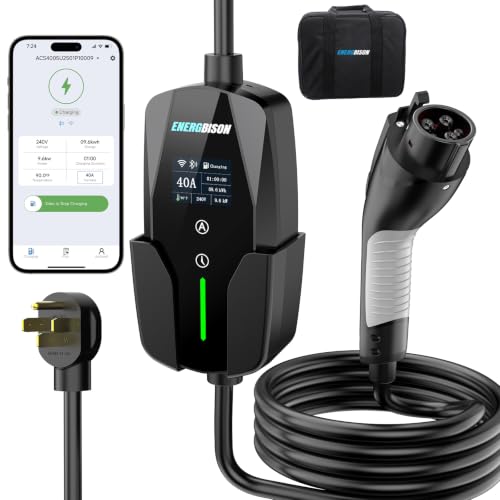
- Mobile app supports scheduling and timing delay
- Adjustable current with LCD status readout
- Portable Level 1 and Level 2 charging flexibility
Best For: drivers who need a portable charger with smart timing controls
Premium Pick

- 48A hardwired Level 2 charging with adjustable current
- WiFi app with time-of-use scheduling and cost tracking
- RFID access, LCD display, and IP65 weatherproof housing
Best For: Drivers wanting a high-power home charger with smart scheduling
Value Choice
ETL Level 2 Charger With Schedule

- App-based schedule charging for off-peak hours
- ETL certified with IP65 weatherproof enclosure
- RFID card and 25-foot J1772 cable included
Best For: Buyers seeking a dependable, lower-cost smart home charger
Smart Off-Peak Charging Pick – EVIQO Level 2 EV Charger J1772 40A
If you want one of the more practical ev chargers with smart scheduling, this EVIQO unit focuses on the basics that matter: easy app control, off-peak charging, and broad J1772 compatibility. It plugs into a NEMA 14-50 outlet, delivers up to 40A, and includes a 25 ft cable that makes garage setup more flexible.
Best For: Drivers who want a plug-in Level 2 charger with app-based scheduling and cost tracking.
Pros:
- Free app lets you start/stop charging, set 6-40A output, and schedule overnight charging.
- Works with every non-Tesla EV using J1772, plus Tesla with the car’s adapter.
- 25 ft cable and plug-in 240V NEMA 14-50 design make installation straightforward.
- UL, ETL, FCC, and Energy Star certifications plus IP66 / NEMA 4 weatherproofing.
Cons:
- Requires 2.4 GHz WiFi for smart features.
- Needs a proper NEMA 14-50 outlet and dedicated 50A circuit.
Overall, this is a strong choice if your priority is scheduled home charging without hardwiring. The combination of app controls, weatherproof construction, and a long cable gives it broad everyday appeal.
Networked App-Control Choice – ChargePoint HomeFlex Level 2 Smart Charger
For shoppers comparing ev chargers with smart scheduling, the ChargePoint HomeFlex stands out for its app ecosystem and proven charging network. This hardwired Level 2 charger supports app control, reminders, smart-home connections, and flexible current settings, making it a solid fit for regular at-home use.
Best For: Hardwired home charging with app controls and access to ChargePoint’s broader network.
Pros:
- ChargePoint Mobile App supports control, reminders, charging data, and smart-home device connections.
- Adjustable 16-50A output and up to 45 mi/hr charging, depending on vehicle.
- UL-certified and Energy Star listed for safe indoor or outdoor installation.
- 23-ft cable and 24/7 support add convenience for daily use.
Cons:
- Hardwired installation requires an electrician.
- WiFi is needed for certain features and troubleshooting.
This model makes sense if you want a dependable smart charger backed by a major charging brand. Its app features are useful, but the hardwired setup means it is less plug-and-play than some alternatives.
Home Energy Integration Pick – Leviton Level 2 Smart EV Charger 40A
This Leviton model is a good fit if you want ev chargers with smart scheduling that also tie into a broader home energy setup. It works with the My Leviton app over Wi-Fi, offers 40A charging, and comes with a 25 ft cable plus a NEMA 14-50P plug for easier installation.
Best For: Homeowners who want Wi-Fi charging control tied into the My Leviton app.
Pros:
- My Leviton app compatibility gives you Wi-Fi control from a familiar home platform.
- 40A Level 2 charging with a 25 ft cable for flexible garage placement.
- NEMA Type 3R enclosure and weather-resistant cable support indoor or outdoor use.
- UL and Energy Star certified, with 24/7 dedicated support.
Cons:
- Plug-in design still depends on having the right NEMA 14-50 receptacle.
- Smart features rely on Wi-Fi connectivity.
Leviton’s charger is especially appealing if you already like its app and home electrical ecosystem. It offers a balanced mix of smart control, weather resistance, and easy installation for a plug-in unit.
Budget Scheduling Upgrade – WiFi App Plug-Play Level 2 EV Charger
If you want ev chargers with smart scheduling and a lower-friction feature set, this plug-play Level 2 unit covers a lot of ground. It supports Wi-Fi app scheduling, charging history, and off-peak timing, while also offering a touch screen for use without the app.
Best For: Drivers who want app scheduling plus a built-in screen for local control.
Pros:
- Wi-Fi app can set charging periods, track cost, view history, and send fully charged notifications.
- Touch screen allows local control of amperage and delayed start without needing the app.
- Up to 48A hardwired or 40A via NEMA 14-50 plug, with a 25 ft cable.
- ETL, FCC, and Energy Star certified, with NEMA Type 3 protection and a durable cable.
Cons:
- Some setup steps are more involved, especially for higher amperage use.
- Notes recommend professional installation for optimal safety and performance.
This charger is attractive if you want scheduling features without giving up a local display. It offers strong flexibility, but the installation and wiring guidance mean it is best suited to buyers comfortable planning the setup carefully.
Smart Off-Peak Home Charging – Autel 50A Wi‑Fi EV Charger
If you want ev chargers with smart scheduling and strong weather protection, the Autel MaxiCharger AC Home is built for home use with app-based control. It supports charging time management, off-peak scheduling, and OTA firmware updates, while the 50A, 12kW output keeps charging speeds competitive for daily top-ups.
Best For: Drivers who want a hardwired level 2 charger with app scheduling and outdoor durability.
Pros:
- Smart app control lets you schedule charging and optimize for off-peak electricity
- Up to 50A / 12kW output for faster home charging
- NEMA Type 4 / 4X protection and 25-foot cable for indoor or outdoor installation
- Wi‑Fi, Bluetooth, and Ethernet connectivity with OTA firmware updates
Cons:
- Hardwired installation may be less convenient than plug-in models
- Higher output requires the right home electrical setup
This is a strong pick if scheduling, reliability, and all-weather use matter as much as charging speed. It combines smart controls with a rugged build, making it well suited to permanent home installation.
Plug-In Scheduling Made Easy – ELEGRP 40A Level 2 EV Charger
For shoppers comparing ev chargers with smart scheduling, the ELEGRP 40A stands out as a plug-in Level 2 option with app-based start/stop control and off-peak scheduling. It pairs 9.6kW charging with a NEMA 14-50 plug, so it fits homes that already have the right outlet and want a simpler install.
Best For: EV owners who want a plug-in charger with app scheduling, RFID access, and outdoor-ready protection.
Pros:
- App control supports start/stop, off-peak scheduling, and energy tracking
- 40A / 9.6kW output delivers fast Level 2 charging
- Plug-in NEMA 14-50 design avoids hardwiring in many setups
- ETL certified with IP66 / NEMA Type 4 weather protection and RFID card access
Cons:
- Requires a compatible 240V outlet for plug-in use
- 40A charging depends on having the proper breaker and circuit capacity
This charger is a practical pick for buyers who want smart scheduling without committing to a hardwired unit. Its mix of app control, RFID convenience, and outdoor durability makes it flexible for many home garages and driveways.
Portable Smart Scheduling – Home 40A EV Charger with App
If your priority is ev chargers with smart scheduling in a portable format, this 40A charger adds mobile app timing delay and adjustable current control. It supports J1772 EVs and PHEVs, shows live charging data on an LCD screen, and is designed for both Level 1 and Level 2 use depending on the outlet.
Best For: Drivers who want a portable charger with app-based scheduling and real-time charging info.
Pros:
- Smart app scheduling and timing delay help shift charging to the hours you choose
- Adjustable current and LCD screen provide more control and visibility
- Supports both Level 1 and Level 2 charging for added flexibility
- IP65 water resistance and multiple safety protections support everyday use
Cons:
- Level 2 charging output is lower than many dedicated 40A home wall units
- Portable design may not suit buyers looking for a permanent installed charger
This is a useful choice if you want scheduling features but need the flexibility to charge in more than one place. It is especially appealing for drivers who value portability, current control, and easy-to-read charging data.
Premium Pick – 48A 11.5kW WiFi EV Station
If you want ev chargers with smart scheduling for a fast home setup, this 48A hardwired Level 2 unit is built around off-peak charging and high output. It supports WiFi app control, time-of-use scheduling, adjustable current, and a 25-foot cable, making it a strong fit for drivers who want overnight charging with more control over cost and charging speed.
Best For: Homeowners who want a hardwired, high-power charger with app-based scheduling and RFID access.
Pros:
- 48A / 11.5kW Level 2 output with adjustable current from 32A to 48A
- WiFi-enabled smart app supports scheduled charging and cost tracking
- Includes RFID card access, push notifications, and 4.3-inch LCD display
- UL 2594, FCC, CE, and RoHS safety certifications with IP65 housing
Cons:
- Hardwire installation is required
- Needs a 60A or higher circuit breaker for 48A charging
- Not recommended for direct sunlight or exposed rain installation
This is the most powerful option in the group, and it stands out if you want smart scheduling plus a higher amperage ceiling for faster top-ups. The tradeoff is installation complexity, but the feature set is well suited to a dedicated home charging station.
Best Portable – 32A Plug-In Smart EVSE
For buyers comparing ev chargers with smart scheduling in a portable format, this plug-in 32A model is designed to be flexible and easy to move. It offers WiFi app scheduling, adjustable amperage, a 25-foot cable, and a NEMA 14-50 plug, so it can work well for home charging when you want smart control without hardwiring.
Best For: Drivers who want a plug-in Level 2 charger with app-based scheduling and portability.
Pros:
- WiFi app supports charging periods, notifications, and charging history
- Adjustable amperage from 16A to 32A for different circuit limits
- Plug-in NEMA 14-50 design makes installation simpler than hardwired units
- ETL and FCC listed with a 25-foot durable cable and NEMA Type 4 protection
Cons:
- Not a native fit for Tesla/NACS vehicles without an adapter
- Some setup steps rely on 2.4GHz WiFi and can require factory reset troubleshooting
- Using a 5-15P adapter reduces charging speed to Level 1
This is a practical pick if you want smart scheduling and easier installation in the same package. It is not the most powerful charger here, but its portability and plug-in convenience make it appealing for many home garages.
Value Choice – ETL Level 2 Charger With Schedule
If you need ev chargers with smart scheduling and want a straightforward home wallbox, this ETL-certified Level 2 model covers the essentials well. It offers app control, schedule charging for off-peak hours, adjustable current, and a 25-foot cable, making it a solid value choice for everyday charging at home.
Best For: Budget-minded buyers who want app scheduling and a reliable J1772 home charger.
Pros:
- Smart app lets you schedule off-peak charging and monitor status in real time
- Adjustable current helps balance faster charging with gentler battery care
- ETL certified, FCC compliant, and housed in an IP65 weatherproof enclosure
- Includes RFID card and a 25-foot cable for convenient household use
Cons:
- Uses a NEMA 14-50 plug rather than a hardwired setup
- Charging speed is described as 8X faster, but output still depends on your circuit and current setting
- Product details are more basic than the higher-feature models above
This model is a good middle-ground option if you want smart scheduling without paying for a higher-output premium unit. It balances useful app features, weather protection, and simple installation in a package aimed at daily home charging.
How We Picked These Ev Chargers with Smart Scheduling
We prioritized charging speed, scheduling flexibility, build quality, and real-world convenience. For home buyers, that means looking at whether the unit supports timed charging, app-based controls, adjustable current, and dependable plug-in or hardwired installation options.
We also considered cable length, weather resistance, certification, and compatibility with common J1772-equipped EVs and plug-in hybrids.
Quick Comparison
If you want the simplest setup, plug-in chargers are usually the easiest to install. If you want the cleanest long-term installation and often the highest output, hardwired models are worth a look. Higher amperage can reduce charging time, but only if your vehicle can accept it and your electrical panel can support it.
Key Buying Factors for Ev Chargers with Smart Scheduling
Scheduling Controls
Look for chargers that let you set start and stop times in an app or on the unit itself. This is especially useful if your utility offers time-of-use rates. Some models add delay timers or current scheduling, which can further help manage load.
Amperage and Power Output
Common home options range from 32A to 50A. Higher output can shorten charging sessions, but your vehicle’s onboard charger sets the actual limit. Make sure the charger, breaker, and wiring all match.
Installation Style
Plug-in chargers using NEMA 14-50 are convenient and portable, while hardwired units can offer a more permanent and often cleaner installation. Choose based on your garage setup, local code, and whether you may move the charger later.
Connectivity and App Features
Wi-Fi is the main feature that enables remote scheduling, usage monitoring, and firmware updates. Bluetooth can help during setup, but Wi-Fi matters more for everyday control. Some chargers also include RFID access or adjustable current settings.
Who Should Buy What
Commuters with predictable overnight charging needs should favor a reliable plug-in model with strong app scheduling. EV owners with higher-range needs or multiple vehicles may prefer a 48A or 50A hardwired charger. If you want maximum value, a straightforward 40A unit with basic scheduling can be enough for most daily drivers.
For apartments, shared garages, or households managing multiple loads, smart scheduling is especially useful because it helps avoid peak demand and better matches charging to your routine.