
The 2-in-1 OBD2 Scanner & Battery Tester review is straightforward: it is built for drivers who want fast answers before they pay for a repair or head out on a trip.
If you want one handheld tool for engine codes and 12V battery checks, this listing makes a clear case.
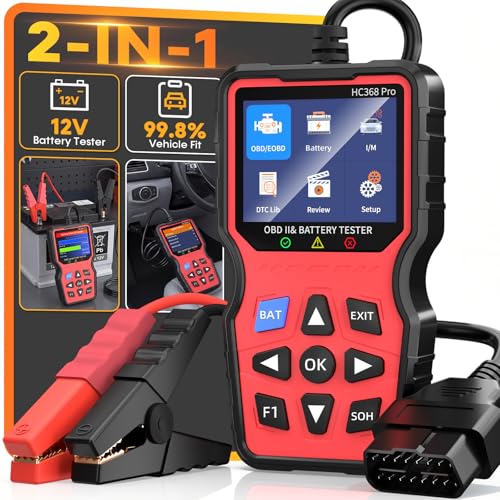
2-in-1 Scanner Review Summary
This 2-in-1 scanner suits DIY owners, new drivers, used-car shoppers, and anyone who wants to verify basic vehicle health without dragging out separate tools.
The appeal is not just that it reads codes; it also tests battery condition, starting performance, and charging-system status, which makes it more useful than a basic code reader when a no-start problem could be electrical rather than engine-related.
Verdict: Best for practical, everyday diagnostics rather than deep professional repair work.
The listing emphasizes quick diagnosis, clear menus, and enough battery data to help you decide whether a problem is likely in the battery, starter, alternator, or the engine side of the car.
Review Scorecard
| Category | Score | Why it earns that score |
|---|---|---|
| Diagnostic usefulness | 9/10 | Combines OBD2 code reading with battery health and charging checks in one device. |
| Ease of use | 8/10 | The listing stresses simple setup, easy menus, and a readable color screen. |
| Battery testing value | 9/10 | Covers CCA, SOC, SOH, internal resistance, cranking, and charging status. |
| Trip-prep practicality | 9/10 | Suits pre-road-trip scans and winter starting checks, which are high-value uses. |
| Clarity of results | 8/10 | Built-in DTC definitions and live data graphs help reduce guesswork. |
| Scope for advanced work | 7/10 | Broad for a handheld unit, but still aimed at owner-level diagnostics, not shop-grade depth. |
| Everyday portability | 8/10 | The compact, color-screen format is easy to keep in the car for occasional checks. |
Key Features and Specifications of 2-in-1 Scanner
The strongest selling point is the dual-purpose design.
According to the listing, this tool can read and clear check-engine codes quickly and also run a 12V battery test that measures key indicators such as CCA, state of charge, state of health, internal resistance, cranking performance, and charging-system status.
That combination matters because many drivers only discover battery weakness after a cold start failure or a vague warning light.
The screen is described as a 2.8-inch HD color display with multiple text colors, which should make results easier to scan at a glance.
The listing also says it includes built-in DTC code definitions, so you are less dependent on searching for the meaning of a fault code before you understand the next step.
Other notable claims from the product page include live data stream viewing with curve graphs, support for 13 languages, compatibility with all 1996+ OBD2 vehicles, support for all 10 OBD2 protocols, and emissions-readiness checks.
The listing also says it supports AGM, regular, and deep-cycle batteries, which broadens its usefulness beyond a single battery type.
Useful listing details:
- Reads and clears check-engine codes
- Runs a 12V battery health test
- Measures CCA, SOC, SOH, internal resistance, cranking, and charging status
- Displays results on a 2.8-inch HD color screen
- Includes built-in DTC code definitions
- Supports live data with curve graphs
- Works with 1996+ OBD2 vehicles
- Supports AGM, regular, and deep-cycle batteries
- Supports 13 languages
- Includes emissions-readiness checks
That feature set makes the product feel aimed at real-world ownership tasks.
It is not trying to be a tablet-sized scan platform; it is trying to shorten the distance between a warning light, a battery concern, and a sensible next move.
Pros and Cons of 2-in-1 Scanner
Pros
- Two tools in one body: code reading and battery testing are both covered.
- Useful battery detail: the battery test is more informative than a yes/no battery check.
- Built for quick decisions: the listing repeatedly emphasizes fast diagnosis and simple menus.
- Good for common ownership scenarios: pre-trip checks, winter checks, used-car inspections, and emissions readiness.
- Color screen and definitions: easier to interpret than bare-bones code readers.
Cons
- Not positioned as a pro-shop diagnostic platform: buyers wanting deep OEM-level diagnostics may need more advanced gear.
- Listing language is broad: some claims are marketing-heavy, so expectations should stay grounded in owner-level use.
- Best value depends on your needs: if you only want occasional code reads, the battery-test half may be extra.
Overall, the pros are strongest when you care about diagnosing the full starting-and-running picture, not just pulling a fault code.
Who Should Buy 2-in-1 Scanner?
This tool makes the most sense for drivers who want a single compact device for routine car health checks.
That includes people preparing for a road trip, drivers in cold climates, and used-car buyers who want to look past a dashboard warning light before making a decision.
It also fits DIY owners who already do small repairs and want to know whether a problem is likely battery-related or engine-related before spending money elsewhere.
The inclusion of battery-health metrics is especially valuable for anyone who has dealt with intermittent no-start issues.
You should probably skip it if you already own a more advanced diagnostic tablet, if you only ever need the simplest possible code reader, or if your work requires deeper professional scanning across a wider system set than the listing clearly explains.
In short: buy it if you want practical clarity, not if you want a full shop ecosystem.
Battery and Code Diagnostics in Real Use
Pre-Trip Safety Checks
The pre-trip angle is one of the clearest use cases here.
A quick code scan plus a battery test can help you catch hidden issues before a highway drive, especially if the car has been sitting, has had recent electrical trouble, or is heading into cold weather.
Cold-Start and No-Start Troubleshooting
When a car struggles to start, the difference between a weak battery and a deeper problem matters.
Because this tool checks battery health, cranking performance, and charging status, it should help you narrow the likely source of a no-start more efficiently than a code reader alone.
Used-Car Inspection
For a used-car buyer, the ability to scan engine faults and check battery condition in the same session is practical.
It does not replace a mechanical inspection, but it gives you a fast read on whether the vehicle is hiding obvious electrical or diagnostic trouble.
Driver-Friendly Readout
The built-in code definitions and color display are important because many owner-level tools fail at the interpretation step.
If the display really is as readable as described, it should reduce the friction that usually keeps people from using a scanner regularly.
Alternatives to 2-in-1 Scanner
If you want a different path, the most credible alternatives are familiar scan-tool brands and product families.
A basic Ancel OBD2 scanner is a common choice if you only need code reading.
A BlueDriver OBD2 scanner is worth comparing if you want a more polished app-based experience.
A FOXWELL OBD2 scanner is another familiar option for buyers who want broader diagnostic coverage in a handheld format.
If battery testing is your main priority, look at a dedicated battery tester from a known automotive tool brand and compare whether you really need the code-reader side at all.
The right choice depends on whether your main pain point is engine codes, battery failures, or both.
Is 2-in-1 Scanner Worth It?
Yes, if you want one tool that covers both engine-code triage and 12V battery testing.
The listing points to a genuinely useful owner-focused diagnostic package: fast code reads, defined fault descriptions, battery-health metrics, live data, and emissions-readiness checks.
It is especially sensible for drivers who want to prepare for trips, troubleshoot winter starting problems, or inspect a used car without immediately visiting a shop.
The value proposition is less compelling only if you already own a stronger diagnostic tool or if you will rarely use the battery-test side.
For most DIY drivers, this is a practical buy rather than a novelty.
If your goal is faster, clearer decisions about whether a problem is electrical, starting-related, or engine-related, the 2-in-1 design earns its place.