
If you want added low-end weight without giving up cabin space, this 10-inch under-seat car subwoofer is built around that exact problem.
It aims to be a compact bass upgrade for drivers who want more presence from a factory-style setup.
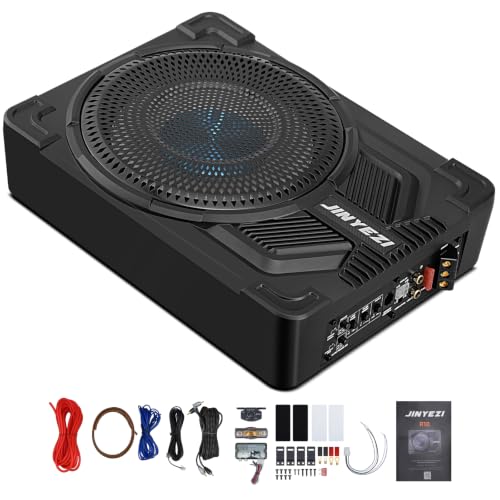
10-Inch 1200W Under-Seat Car Subwoofer Review Summary
This 10-inch under-seat car subwoofer makes the most sense for buyers who want a space-saving bass solution rather than a full trunk system.
The listing points to a fairly focused formula: a Class D amplifier section, a 2-ohm woofer, bass boost control, an independent low-pass filter, and compatibility features meant to work with factory head units.
The appeal is straightforward: it tries to deliver usable low-frequency output in a format that fits under most seats, while keeping installation requirements moderate.
That makes it attractive for trucks, SUVs, MPVs, UTVs, and ATVs, especially when you want more bass but do not want to add a bulky enclosure.
Review Scorecard
| Category | Score | Buyer assessment |
|---|---|---|
| Bass output potential | 8/10 | 1200W peak, 280W RMS, and a 2-ohm woofer suggest meaningful low-end support for a compact unit. |
| Space efficiency | 10/10 | The under-seat aluminum housing is the product’s main advantage. |
| Installation flexibility | 8/10 | High/low-level inputs and a built-in converter help it work with more systems. |
| Thermal and electrical protection | 8/10 | Thermal, short-circuit, and overload protection add practical confidence. |
| Sound tuning control | 7/10 | Bass boost and an independent low-pass filter provide useful adjustment, though not a deep tuning suite. |
| Build and durability | 8/10 | Thickened aluminum housing and heat-dissipation channels point to a robust design. |
| Overall buyer fit | 8/10 | Strong fit for space-conscious drivers who want bass enhancement, not a competition setup. |
In practical terms, this is a good fit if you want better bass from a discreet package and are comfortable with the limits of an under-seat format.
It is less compelling if you are chasing deep sub-bass at very high output, because the form factor and published specs suggest an upgrade for everyday listening rather than show-car force.
Key Features and Specifications of 10-Inch 1200W Under-Seat Car Subwoofer
The product listing centers on a few concrete hardware choices that matter to buyers.
It uses an upgraded IRS2095 IC plus IRL540N MOSFET Class D amplifier design, and the listing claims efficiency up to 95%.
It also mentions a 50mm voice coil and a 2-ohm woofer, which are the core indicators of its power-handling orientation.
The enclosure is a thickened aluminum housing with dual-sided heat dissipation channels.
That matters because under-seat subwoofers often need to survive in tighter, hotter spaces than traditional trunk setups.
The aluminum shell also helps suppress resonance, which can support cleaner bass behavior in a compact format.
Other useful listed details include:
- RMS power: 280W at 2 ohms
- Peak power: 1200W
- Signal-to-noise ratio: greater than 90dB
- Frequency response: 20Hz to 180Hz
- Low-pass filter: 40Hz to 180Hz
- Bass boost: 0dB to 12dB
- Fuse: 40A
- THD: less than 0.3% from 20Hz to 180Hz
- Dimensions: 13.38 x 10.03 x 3 inches
For connectivity, the listing says it includes a built-in high-to-low level converter, REM wire for auto-power-on, RCA cables made with oxygen-free copper, and 8AWG cables with copper terminals.
Those are the kinds of details that reduce friction for buyers mixing aftermarket gear with factory audio systems.
Pros and Cons of 10-Inch 1200W Under-Seat Car Subwoofer
Pros
- Space-saving design that fits under most seats
- Class D amplification should help efficiency and heat management
- Useful for factory head units thanks to the built-in converter
- Independent low-pass filter and bass boost allow basic tuning
- Thermal, short-circuit, and overload protection improve day-to-day practicality
- Aluminum housing and heat channels are a sensible choice for confined installs
Cons
- Under-seat format limits how much deep bass it can realistically move
- The tuning controls are useful, but not especially advanced
- Buyers looking for a hard-hitting trunk sub may outgrow it quickly
- Peak power language can look large, but the RMS figure is the more useful number
The biggest positive here is not raw output alone.
It is the combination of moderate bass capability, compact size, and easier integration.
The biggest drawback is equally clear: a subwoofer this small cannot fully replace a larger enclosure if your main goal is very low, room-filling bass.
Who Should Buy 10-Inch 1200W Under-Seat Car Subwoofer?
This product is best for drivers who want a noticeable bass upgrade without changing the whole vehicle layout.
If you have an SUV, truck, MPV, UTV, or ATV and need to preserve cargo or legroom, the under-seat format is a strong advantage.
It also makes sense for buyers using a factory or lightly modified head unit.
The built-in high-to-low converter and REM wire support suggest the system is designed to be easier to integrate than a more demanding aftermarket subwoofer setup.
You should consider skipping it if:
- You want very deep sub-bass at high volume
- You already have a dedicated trunk sub system
- You need detailed tuning and advanced system control
- You expect the same physical impact as a larger boxed subwoofer
For those users, a bigger enclosure or a more powerful dedicated sub stage is the better path.
For everyone else, this is a reasonable compact bass upgrade with practical installation advantages.
Bass Tuning and Installation Fit of 10-Inch 1200W Under-Seat Car Subwoofer
How the Tuning Works
The useful part of the tuning layout is that it keeps the interface simple.
A 40Hz to 180Hz low-pass filter and 0dB to 12dB bass boost give you enough control to match the sub to your speakers without needing a full processor-level setup.
That is the right amount of flexibility for a compact add-on, because most buyers just want the low end to blend cleanly.
Why the Inputs Matter
The listing’s high-level and low-level input support is a major practical advantage.
It means the subwoofer is positioned for both factory and aftermarket systems, which expands its audience beyond people already running a traditional amp/sub install.
The built-in converter is especially relevant if you are trying to keep the original head unit.
What the Aluminum Housing Contributes
The aluminum enclosure is not just cosmetic.
In this product category, enclosure rigidity and heat control both matter.
The thicker housing should help with durability, and the dual-sided heat dissipation channels line up with the Class D design’s lower thermal load.
That combination is sensible for a unit that will likely live under a seat with limited airflow.
Where the Compact Format Helps and Hurts
The compact footprint is the product’s main selling point, but it also defines its ceiling.
You are buying convenience, not maximum displacement.
That is why the most realistic expectation is a tighter, more controlled bass layer that fills out the soundstage, rather than a system that turns every track into a bass demo.
Alternatives to 10-Inch 1200W Under-Seat Car Subwoofer
If you want a few credible comparison points, look at compact under-seat or powered subwoofer lines from Alpine, Kicker, Pioneer, Rockville, and JBL.
These are common Amazon search starting points when buyers want different blends of size, power, and tuning flexibility.
- Alpine powered subwoofer
- Kicker powered subwoofer
- Pioneer under seat subwoofer
- Rockville under seat subwoofer
- JBL powered subwoofer
These alternatives matter because the right choice depends on what you value most.
If you want a more established car-audio brand, one of the mainstream powered-sub lines may feel safer.
If you want a similar compact install with different tuning or packaging, a competitor in the same under-seat category may fit better.
Is 10-Inch 1200W Under-Seat Car Subwoofer Worth It?
Yes, if your priority is compact bass enhancement with straightforward integration.
The listed specs point to a sensible under-seat powered subwoofer for drivers who want more low-end presence without sacrificing space or redesigning the system.
No, if you want the deepest bass possible or a system with more advanced control.
In that case, a larger enclosure and more serious amplification will be the better investment.
For the right buyer, though, this model looks like a practical, space-efficient way to add bass where a full-size sub would be too much.